

 ·
7 minute read
·
7 minute read
The standard test drive lasts about 20 minutes. You leave the dealership forecourt, do a loop of the local roads, park back where you started, and the sales advisor asks how it felt.
For a petrol or diesel car, that’s probably enough. The buyer knows what an internal combustion engine feels like. They’re evaluating this particular car against years of accumulated reference points.
For an EV, it is almost entirely the wrong experience.
22% of the car buyers we surveyed in Germany now drive fully electric vehicles — and the dealers and OEMs we speak with are consistent on one point: the format of the EV test drive needs to change. Not the vehicle. Not the sales process. The test drive itself. What resolves EV purchase hesitancy, they tell us, is not a 20-minute city loop. It’s getting out of the city, covering real distance, and arriving back without needing to stop and charge. The buyer who experiences that doesn’t have a range anxiety problem anymore. The buyer who only experiences a forecourt circuit often still does.
The test drive format is catching up with the technology. The booking process hasn’t moved at all.
22% of respondents in the Car-Buyer Experience Report 2026 now drive fully electric vehicles — in a sample of experienced, high-intent German car buyers.
Range Anxiety Is Not a Knowledge Problem. It’s an Experience Problem.
Most EV sceptics already know, intellectually, that modern electric cars have sufficient range for typical daily use. They’ve read the specs. They’ve seen the comparisons. They are not uninformed.
What they haven’t done is feel it.
Range anxiety is not primarily a data problem, it is a confidence problem, and confidence is built through experience, not information. The buyer who has driven an EV from the city to a destination 80 km away and returned without the charge gauge becoming a source of stress is a different buyer from the one who hasn’t. The concern has been tested against reality and passed. That’s a conversion event.
A 20-minute test drive cannot replicate that. It can demonstrate acceleration, ride quality, interior comfort, and the feel of regenerative braking. It cannot answer the question that is actually blocking the purchase for a significant proportion of hesitant EV buyers: will this car work for the way I actually drive?
What dealers and OEMs have found works is the weekend test drive; handing the car to the buyer for 48 or 72 hours, sending them out of the city, letting them come back having used the car as they would actually use it. That experience does what no amount of spec comparison or 20-minute showroom drives can: it makes the abstract concrete.
|
The Test Drive Is Becoming More Important for EV Sales, Not Less
This is a counterintuitive moment in the EV transition. As digital retail grows, as configurators become more sophisticated, as buyers do more and more of their research online before any dealership contact — the conventional wisdom might suggest that physical test drives are becoming less central to the purchase journey.
For EVs, the data and the dealer experience say the opposite.
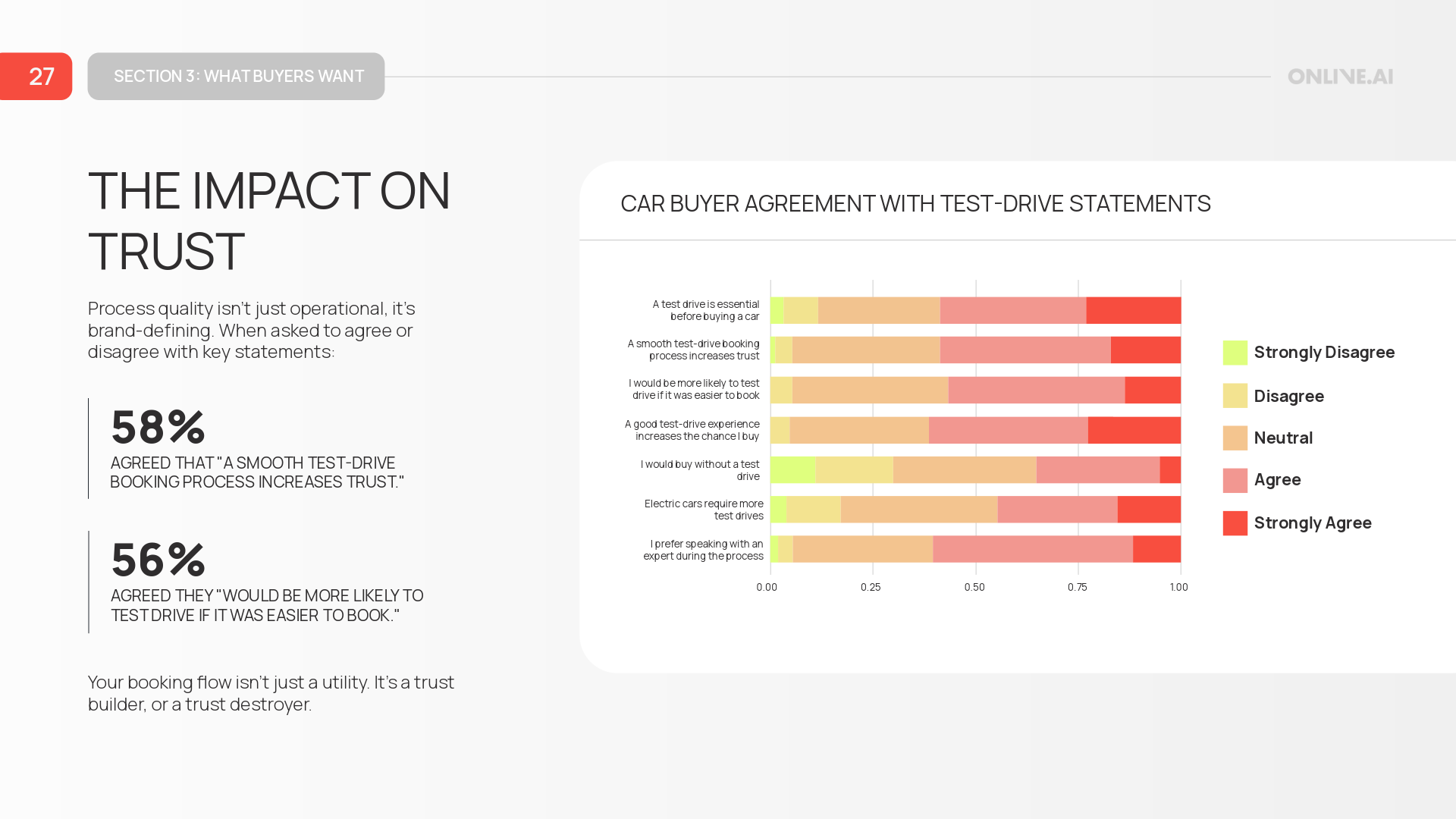
Our research found that buyers broadly agree with the statement that electric cars require more test drives than their ICE equivalents. And the dealers we speak with are not just offering extended test drives as a nice-to-have — they’re positioning them as the primary trust-building tool in the EV conversion funnel.
This makes the booking process not less important for EVs, but more. If the test drive is the critical conversion event — the moment that resolves range anxiety and tips the purchase decision — then every barrier that prevents a buyer from reaching that moment is directly costing EV sales. The test drive format is evolving. The booking infrastructure that enables access to it is not keeping up.
The Booking Process Is Built for a Different Era
Here is where the structural problem becomes commercially urgent.
EV buyers are, by profile, among the most digitally engaged car buyers in the market. They have researched extensively online. They are comfortable with digital tools. They expect digital processes to work, because the digital processes they use in every other part of their lives do.
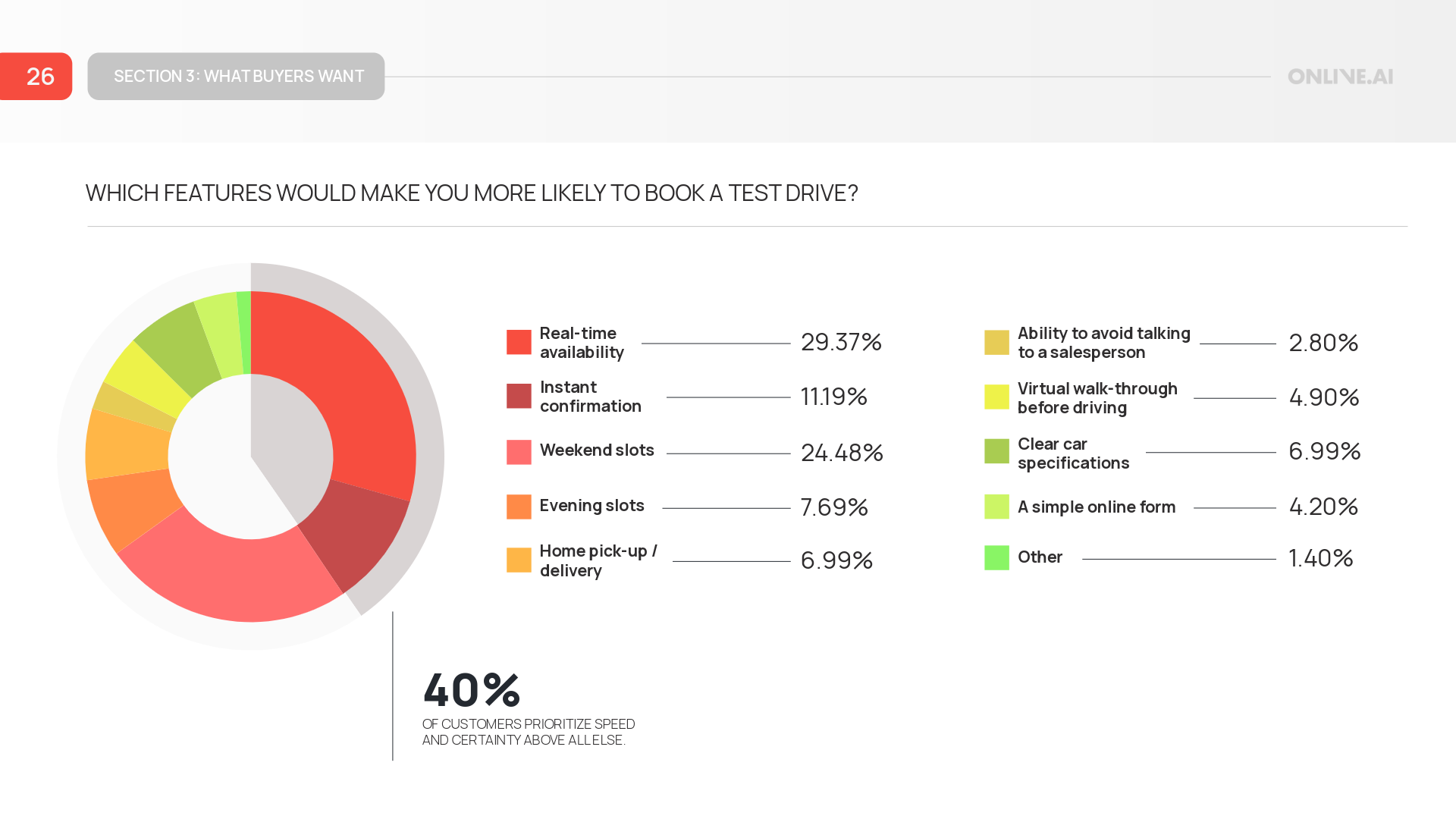
And yet the booking process they encounter is built for a previous decade. Across our full survey sample of 310 German car buyers, 59% of test drives are still booked by walk-in or phone call. 69% of research happens on mobile. 40% of buyers say real-time availability and instant confirmation is their top priority when booking. “No clear availability” ranks as the number one barrier to booking a test drive.
Apply those figures to a buyer who wants a weekend test drive and the friction compounds. It’s not just: can I book a slot? It’s: can I book a specific type of slot, like a longer, extended drive or a weekend test drive through a channel that reflects how I’ve been doing everything else in this research process? For most brands, the answer is no.
A buyer who has spent three evenings comparing EV ranges, watching real-world driving videos on their phone, and reading owner forum discussions about charging behavior, and who then wants to book a weekend test drive, should not have to phone a dealership during business hours to do it. That discontinuity is not just inconvenient. It signals a gap between the product the brand is selling and the experience it is delivering.
59% of test drives across our car buyer sample are still booked by walk-in or phone call, while 69% of car research happens on mobile.
.png?width=1920&height=1080&name=Car_Buyer_Experience_Report_Onlive-19-Content%20Heavy.pdf%20(9).png)
One Shot. Bigger Stakes.
As we explored in Post 3 of The Friction Report, 45% of car buyers take only one test drive before making their purchase decision. One.
For EV buyers, that single opportunity carries more weight than in any other segment. An EV buyer who takes their one test drive as a 20-minute city loop at your competitor’s dealership hasn’t just experienced a different car. They’ve built their confidence — or failed to — around a different brand’s product and a different brand’s process. If range anxiety wasn’t resolved, they may defer the purchase entirely. If it was resolved, they almost certainly won’t come back to start over with you.
.png?width=1920&height=1080&name=Car_Buyer_Experience_Report_Onlive-19-Content%20Heavy.pdf%20(7).png)
56% of our respondents said they would be more likely to test drive if it was easier to book. In the EV context, where the extended test drive is the primary confidence-building event, the cost of not making that booking frictionless is a purchase decision that never reaches its natural conclusion.
What an EV-Ready Booking Experience Actually Requires
Fixing EV test drive booking is not a separate initiative from fixing the general booking problem. The baseline requirements are the same: real-time availability, instant confirmation, mobile-first access, and conversational channel options, preferred by 30% of buyers across our full sample for WhatsApp and AI-assisted chat.
But the EV context adds specific requirements that a generic booking system is not designed to handle:
- Extended slot availability. A weekend test drive is a categorically different booking from a 20-minute afternoon slot. The system needs to support it — and communicate it clearly as an option at the point of booking, not as something the buyer has to know to ask for.
- Charge status confirmation. A buyer collecting a car for a weekend range test needs to know it will be fully charged and ready. Including this in the automated booking confirmation eliminates a practical concern that, if left unaddressed, can generate a pre-visit cancellation or a trust-eroding moment on arrival.
- Expert access at the booking stage. EV buyers arrive with more questions than ICE buyers. A conversational booking interface that can engage with those questions — charging compatibility, range calculation for a specific journey, software features — before the test drive begins converts the booking interaction itself into a trust event, not just an appointment slot.
- Route or destination guidance. Dealers and OEMs who run extended test drive programmes often provide suggested routes — drives that are long enough to demonstrate real-world range performance without requiring charging. Including this in booking communications turns the experience from open-ended to purposefully designed, which reduces pre-drive anxiety and increases the likelihood of a productive outcome.
None of these requirements is technically complex. They are the natural output of a booking platform designed to handle the nuance of an automotive purchase conversation, one that treats the test drive not as a calendar slot but as the pivotal sales event it has become in the EV category.
The Strategic Implication
The EV transition has made the test drive more important, not less. It has also made it more format-specific; the standard 20-minute spin was adequate for a product the buyer already understood. It is not adequate for a purchase decision that rests on resolving a fundamental question about real-world performance.
Brands that recognise this and build booking infrastructure around it: extended slots, real-time availability, conversational access, expert signposting, mobile-first confirmation, are not just improving a process. They are removing the primary barrier between an interested EV buyer and a purchase decision.
The vehicles have made the transition. The booking experience needs to follow.
.png)
.png)
.png)