

 ·
6 minute read
·
6 minute read
For most people, buying a car is the second biggest financial decision they will ever make. Behind only a home.
Think about what that means in practice. Years of saving. Months of research. Countless evenings spent comparing models, reading owner reviews, watching real-world test videos. The decision involves finance agreements, insurance considerations, depreciation calculations, family logistics. It is not an impulse buy. It is, for many buyers, the result of sustained deliberation over a significant portion of their disposable income.
And then they arrive at the booking step.
They find a form that says “someone will call you back.” Or a phone number with business hours. Or a calendar that shows no availability for the next two weeks, with no explanation. Or nothing at all, just a static “contact us” page.
The gap between the weight of the decision and the quality of the process that facilitates it is one of the most consequential mismatches in automotive retail. It is also, largely, an avoidable one.
The Decision Warrants the Process
When someone buys a house, the process around the decision reflects its significance. There are solicitors, surveyors, mortgage advisors, staged viewings. The infrastructure around the purchase is commensurate with what is at stake.
Automotive retail has never fully applied this logic. The product, particularly at the premium end of the market, has become genuinely excellent. Design, engineering, technology, safety, the vehicle itself has evolved significantly. But the buying process, particularly the critical digital touchpoints that now precede any showroom visit, has not kept pace.
89% of car buyers research online before purchasing. For the majority, that research is conducted on a smartphone. They are spending real hours — often spread across weeks — making an informed, considered decision. By the time they are ready to take the next physical step and book a test drive, they have earned the right to a process that meets them where they are.
Instead, most encounter a booking experience designed around operational convenience rather than buyer experience. The question “how do I make it easy for staff to manage appointments?” has dominated. The question “how do I make it easy for a high-intent buyer to take the next step?” has not..png?width=1920&height=1080&name=Car_Buyer_Experience_Report_Onlive-19-Content%20Heavy.pdf%20(9).png)
The Premium Buyer Has Higher Expectations — and Lower Patience
This gap is sharpest at the premium end of the market.
Premium car buyers are not purchasing a product in isolation. They are purchasing an experience. The ownership journey, the service relationship, the sense that the brand understands and values them as a customer. They are paying, in part, for the quality of every interaction with the brand. That expectation does not begin at the showroom door. It begins at the first digital touchpoint.
Research among experienced German car buyers conducted for Onlive.ai’s Car-Buyer Experience Report 2026 found that 42% of respondents drove a premium brand, compared to approximately 25% in the broader German market. These are buyers with established benchmarks for what good looks like. They experience premium service in hotels, in other retail categories, in the apps and platforms they use daily. The comparison set is broad, and the automotive booking experience is losing ground against it.
When a buyer who has been researching a €60,000 vehicle for two months encounters a booking form that says “we’ll be in touch,” the cognitive dissonance is immediate. The product signals one standard. The process signals another. That mismatch is not neutral, it is, for a meaningful proportion of buyers, a signal about the brand’s attention to detail and its genuine interest in their custom.
42% of premium-brand car buyers in the Onlive.ai research sample — versus 25% nationally. Premium buyers have higher expectations of every brand interaction, including booking.
What Buyers Actually Want at the Booking Step
The requirements are not exotic. They are the same standards buyers have come to expect from digital experiences in every other high-consideration category.
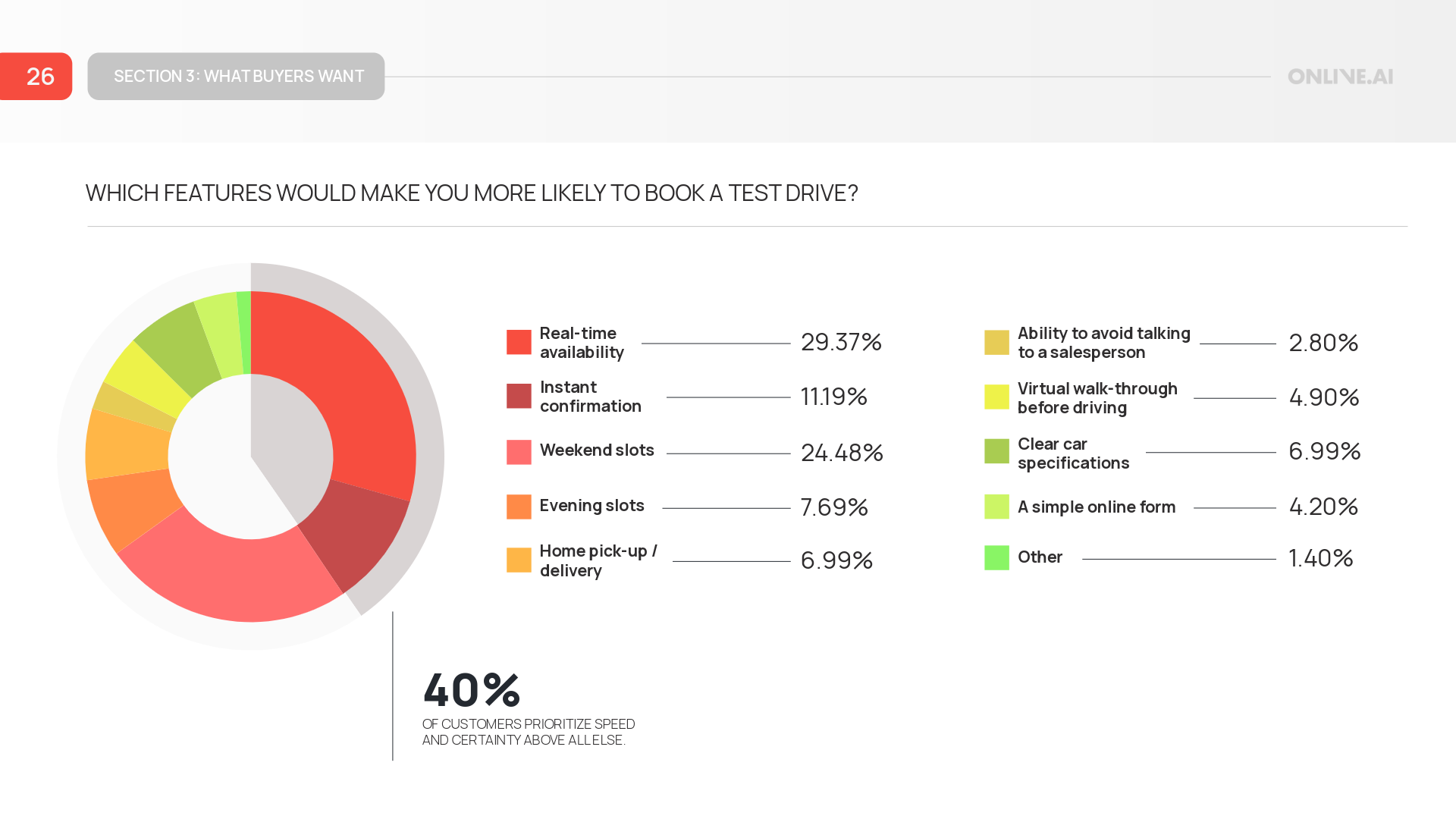
Real-time availability. The ability to see open slots without making a phone call — the same way a buyer books a restaurant, a GP appointment, or a hotel room. 40% of car buyers cite this as their single top priority when booking a test drive, yet “no clear availability” consistently ranks as the number one barrier to booking in the research.
Instant confirmation. Not “someone will call you.” A confirmed slot, immediately, with the details they need. This is the baseline expectation in 2026 for any time-sensitive transaction. Car buying is not exempt.
Mobile access. 69% of buyers conduct their car research on mobile. The booking step needs to work in the same environment — not route the buyer to a desktop form or a phone number.
Channel choice. A growing proportion of buyers — around 30% in recent research — prefer to book via conversational channels: WhatsApp, AI chat, or similar. For a second-biggest-purchase decision, the ability to ask questions in the booking process rather than simply submit a form is not a luxury. It is a reflection of the weight of the decision.
None of these requirements is technically ambitious. They exist in adjacent industries and categories. Their absence in automotive booking is a choice (often an unconsidered one) not a technical constraint.
The Cost of Getting This Wrong
The commercial consequence of booking friction is not abstract.
45% of car buyers take only one test drive before making their purchase decision. One. The buyer who arrives at your booking process with genuine intent, hits friction, and completes their single test drive with a competitor, is gone. Not temporarily delayed. Gone.
56% of buyers say they would be more likely to take a test drive if the booking process were easier. That is more than half of your potential test drive volume sitting on the table, constrained not by desire but by process.
And 58% of buyers say that a smooth booking process directly increases their trust in the brand, before any showroom interaction, before any human contact, before they have sat in the car. The booking process is forming brand impressions for the majority of buyers. Right now, for many brands, those impressions are being formed by a callback queue.
For the second biggest purchase of most people’s lives, the margin for error at this moment is small. The buyer has done the work. They have arrived with intent. What they need is a process that deserves the decision they are trying to make.
56% of car buyers say they would be more likely to test drive if booking were easier. That is more than half of potential test drive volume constrained by process, not intent.
The Showroom vs. the Journey
Automotive brands invest significantly in the showroom. The environment, the lighting, the product displays, the training of sales advisors. These investments are real and they matter. But they are investments in the end of the journey, not the middle of it.
The data consistently tells us that by the time a buyer walks through the showroom door, the brand impression is largely formed. The purchase influence factor rankings from buyer research are telling: the test drive experience is the second most influential factor in the purchase decision, after price. The dealership experience itself — the thing the showroom investment is designed to optimise — ranks last.
This does not mean the showroom doesn’t matter. It means that securing the test drive is the prior condition. A buyer who never reaches the showroom because the booking process created too much friction is a buyer the showroom investment will never reach.
The second biggest purchase of most people’s lives deserves a digital process that reflects its significance, not as a brand nicety, but as a commercial priority. The brands that close this gap will convert the intent that others are losing to friction.
Onlive.ai’s in-chat test drive booking delivers real-time availability, instant confirmation, and conversational booking across WhatsApp and web — designed for the weight of the decision buyers are trying to make. Book a demo to see it in action.
.png)
.png)
.png)