

 ·
6 minute read
·
6 minute read
WhatsApp has over 2 billion active users worldwide. In Germany, it is the dominant messaging platform, used daily by the vast majority of smartphone owners to communicate with friends, family, and increasingly, businesses.
Car buyers use it too. And according to our research, a significant share of them would prefer to use it to book a test drive.
They can't.
This post is about that gap, where it comes from, what it costs automotive brands, and why the window to act on it is narrow. Based on original research conducted with 310 car buyers in Germany as part of the Car-Buyer Experience Report 2026, the data makes the conversational commerce automotive opportunity impossible to ignore.
What Buyers Actually Said About Booking Preferences
When we asked 310 German car buyers how they would prefer to book a test drive, the results revealed a clear and largely unmet demand for conversational channels.
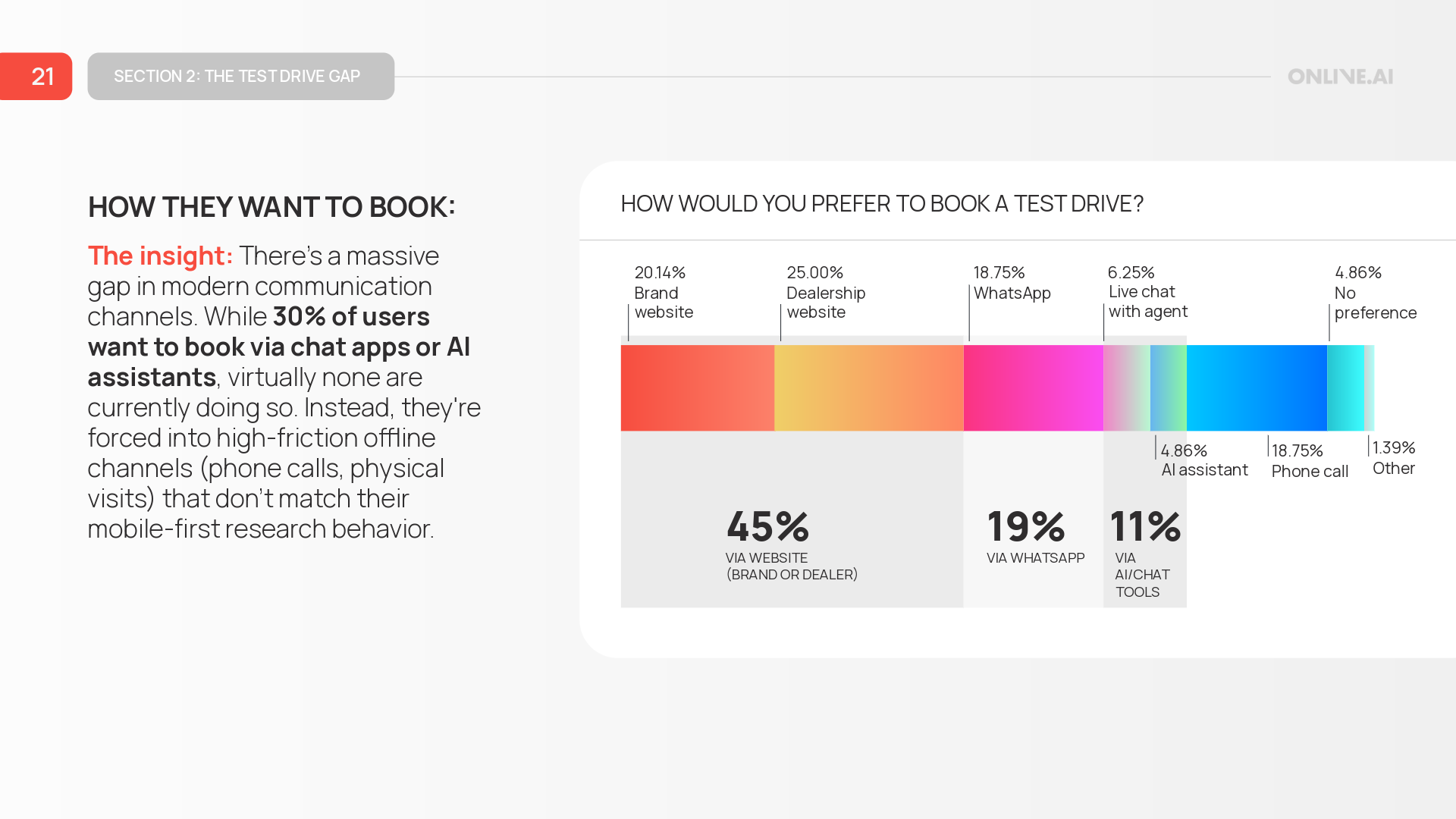
The top preferred channels were digital and self-service: 25% chose dealership website, and 20% chose brand website. But the finding that stands out, the one that most automotive brands have not yet acted on, is this:
30% of buyers prefer to book a test drive via WhatsApp (19%) or an AI/chat tool (11%). Almost none currently can.
To put that in context: nearly one in three car buyers wants to initiate a test drive booking through a messaging interface. WhatsApp alone — preferred by 19% of respondents — outranked phone calls (19% preference) as a booking channel. Buyers have already decided that conversational channels are how they want to communicate. The automotive industry hasn't caught up.
The gap becomes even more striking when you compare preferred channels against actual booking behaviour. In reality, 37% of test drives are booked by in-person walk-in, and 22% by phone call. The channels buyers want to use — chat, WhatsApp, AI assistant — collectively account for a fraction of actual bookings today.
.png?width=1920&height=1080&name=Car_Buyer_Experience_Report_Onlive-19-Content%20Heavy.pdf%20(9).png)
Why WhatsApp? Understanding the Behaviour Behind the Preference
The WhatsApp preference isn't arbitrary. It reflects how buyers already manage high-consideration decisions in their daily lives.
Consumers use WhatsApp for everything from organising appointments to communicating with local service providers. The app is present on virtually every smartphone. Notifications are seen. Messages are read. Responses are expected within hours, not days.
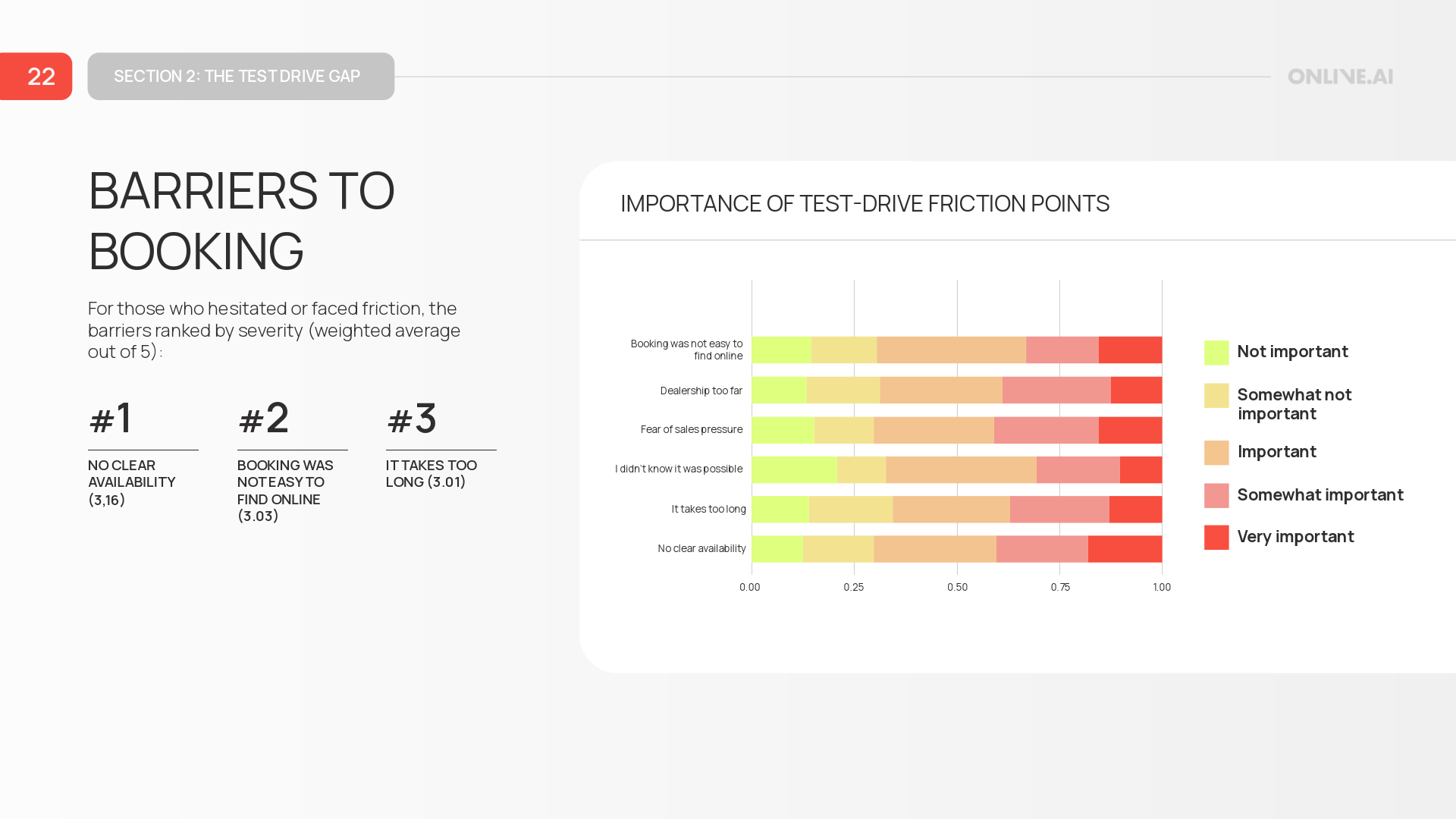
Contrast this with the current test drive booking experience for most automotive brands. A buyer visits the website, finds no real-time availability, encounters a 'contact us' form, submits their details, and waits for a callback, often the next business day. For a buyer researching at 9 PM on a Tuesday, that friction is a conversion killer.
WhatsApp booking sidesteps all of that. It allows the buyer to initiate the interaction in the channel they're already in, at the moment they've decided to act, not hours later. The response can be instant, confirmation is immediate, and the entire booking can happen in a conversation thread the buyer will find again the next morning on the same device they used to research.
This is precisely why 56% of buyers in our research agreed they would be more likely to test drive if the booking process were easier. The demand isn't for more marketing. It's for a simpler path to action.
The Trust Dimension: Why Channel Choice Is a Brand Signal
The preference for WhatsApp and conversational channels isn't only about convenience. It's also about trust.
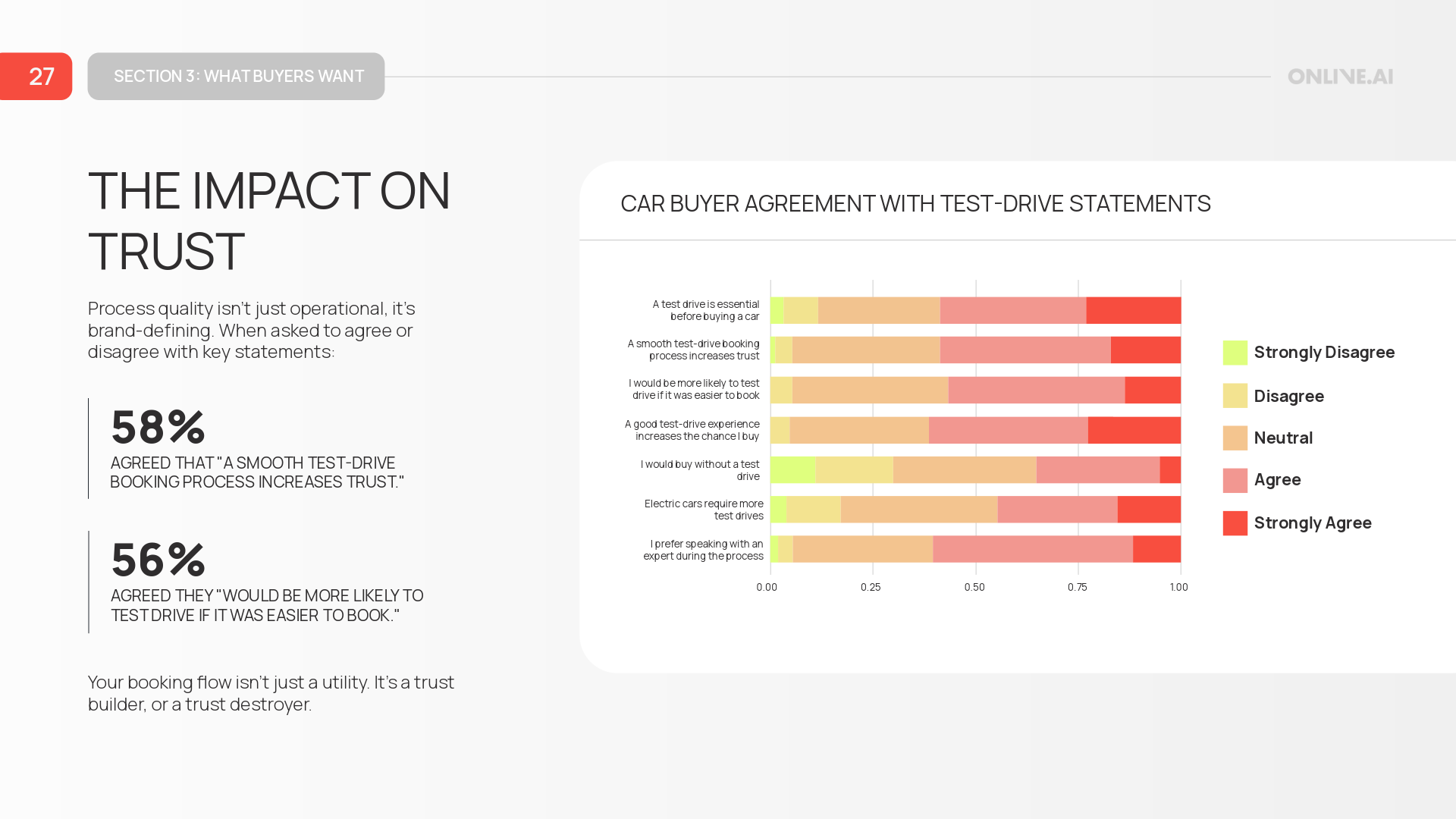
Our research found that 58% of buyers agreed that a smooth test drive booking process increases their trust in a brand. This is a significant finding — and one that reframes the booking step from an operational task to a brand moment.
58% of car buyers agree that a smooth test drive booking process increases their trust in the brand.
Think about what this means for a brand that currently offers only a phone call or walk-in booking option. Every time a mobile-first buyer hits that wall, they're not just experiencing friction — they're forming an impression. A brand that hasn't solved basic booking convenience signals that its digital experience hasn't kept pace. And for OEMs investing heavily in electric vehicle technology, brand positioning, and premium CX narratives, that's a material reputational risk.
Conversely, a brand that offers WhatsApp or chat-based booking is communicating something different: that it has built its customer experience around how buyers actually want to interact, not around legacy operational convenience. In a market where 52% of buyers are undecided about repurchasing the same brand, that signal matters.
The link between booking process quality and brand trust also has a direct commercial implication. The test drive experience ranks as the #2 most influential factor in the purchase decision, behind only price. A booking process that builds trust sets up the test drive to do what it's supposed to do: convert intent into sale.
Why Automotive Brands Haven't Moved — Yet
Given the scale of the preference data, the obvious question is: why haven't automotive brands already deployed WhatsApp and conversational booking at scale?
Several structural reasons explain the lag:
- Legacy CRM and DMS infrastructure wasn't built to handle inbound messaging channels. Connecting WhatsApp to appointment calendars, availability systems, and lead records requires integration work that many dealers and OEMs haven't yet prioritised.
- Compliance and data security requirements, particularly TISAX in the European automotive context, have made some brands cautious about third-party messaging tools that haven't been certified for automotive data handling.
- Organisational ownership of the booking channel is often split between marketing, sales, and IT, creating coordination friction that delays adoption.
- The incumbent phone and walk-in channels still produce bookings, which reduces the perceived urgency to change.
None of these barriers are insurmountable. And the brands that navigate them first will operate in a differentiated position — serving 30% of buyers in the channel they prefer, while competitors still rely on a model that requires a phone call.
The compliance barrier, in particular, is often overestimated. Platforms built specifically for automotive conversational commerce carry the relevant certifications and have solved the integration layer — removing the primary technical objections that have delayed deployment.
The First-Mover Window
Market windows for differentiation in automotive digital CX tend to be short. Features that are novel today — online configuration tools, digital finance applications, virtual walkarounds — become table stakes within two to three years of widespread adoption.
WhatsApp and conversational booking is currently in the pre-adoption phase. Almost no automotive brand offers it at scale. That means the brand that moves first has the opportunity to define the experience — and to capture the loyalty of a buyer segment that has been underserved by every competitor.
1 in 5 car buyers already prefers WhatsApp for test drive booking — a channel virtually no automotive brand currently offers.
The commercial logic is straightforward. With 45% of buyers taking only one test drive before purchasing, the brand that captures the booking moment wins the sale. If 19% of your market wants to use WhatsApp and you're the only brand that lets them, you're not just more convenient — you're removing a reason to go elsewhere.
This is also a retention play. Post-purchase, WhatsApp and chat channels become a natural vehicle for service reminders, follow-up communications, and future purchase conversations. The buyer who booked their test drive via WhatsApp has already opted into a channel where ongoing communication feels natural.
What Conversational Test Drive Booking Actually Looks Like
For OEMs and dealer groups evaluating this channel, it's worth being specific about what the implementation looks like in practice — and why it's more accessible than it might appear.
A WhatsApp or chat-based test drive booking flow typically works as follows:
- A buyer visiting the brand or dealer website encounters a chat interface — either embedded in the page or accessible via a WhatsApp button.
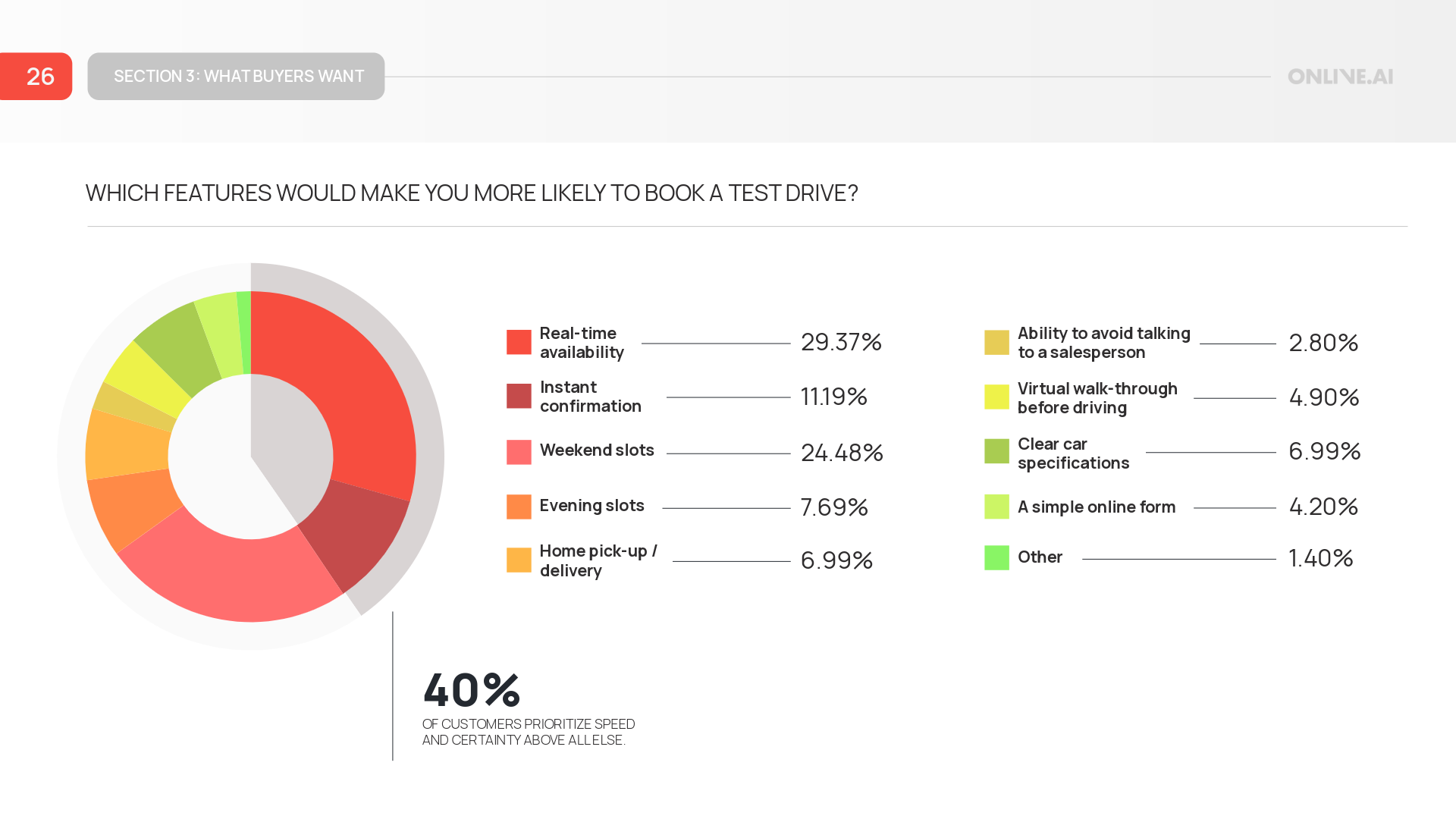
- An AI concierge initiates a qualifying conversation: which model, which location, preferred dates. This can happen instantly, at any time of day or night.
- If the buyer has high intent, the AI presents real-time availability from the dealer calendar and confirms the booking within the conversation.
- The buyer receives confirmation in the same chat thread — with a calendar link and dealer contact details.
- The dealer receives a qualified, pre-confirmed lead with full context — model interest, preferred test route, timeline — before they ever speak to the buyer.
The critical difference from a traditional booking flow is that the entire process — from initial engagement to confirmed appointment — happens within a single conversational session, on the buyer's preferred channel, without requiring them to switch to email, find a phone number, or wait for a callback.
For the buyer, it feels like messaging a knowledgeable contact. For the brand, it's a qualified booking with zero BDC resource required.
The data says 30% of buyers want this. The technology exists. The first-mover window is open.
.png)
.png)
.png)