

 ·
6 minute read
·
6 minute read
The automotive purchase decision factors that actually drive car buyers to say yes — ranked by 310 real buyers in Germany — tell a story that contradicts where most OEMs and dealer groups are putting their money.
Price came first. No surprise there. But what sits at #2 — above expert advice, above financing options, above the entire dealership experience — is the test drive. Not the showroom. Not the coffee. Not the sales consultant's product knowledge.
The test drive. Score: 4.55 out of 5.
And dealership experience? Dead last. Score: 2.06.
We pulled this data from the Car-Buyer Experience Report 2026, our survey of 310 car buyers in Germany examining what actually moves the needle at the moment of purchase. The hierarchy is clear — and it has direct implications for where automotive brands should be directing their digital investment right now.
So let's be real: this isn't a demand problem. It's a process problem. And the lays out exactly where the friction lives, and what buyers actually want instead.
The ranking that should reframe your budget conversation
So here's the thing about conventional wisdom in automotive retail: it tends to flow toward the visible. New showroom fit-out. Premium coffee machine. Trained sales staff in tailored suits.
Those investments are real. But the data doesn't support them as conversion drivers.
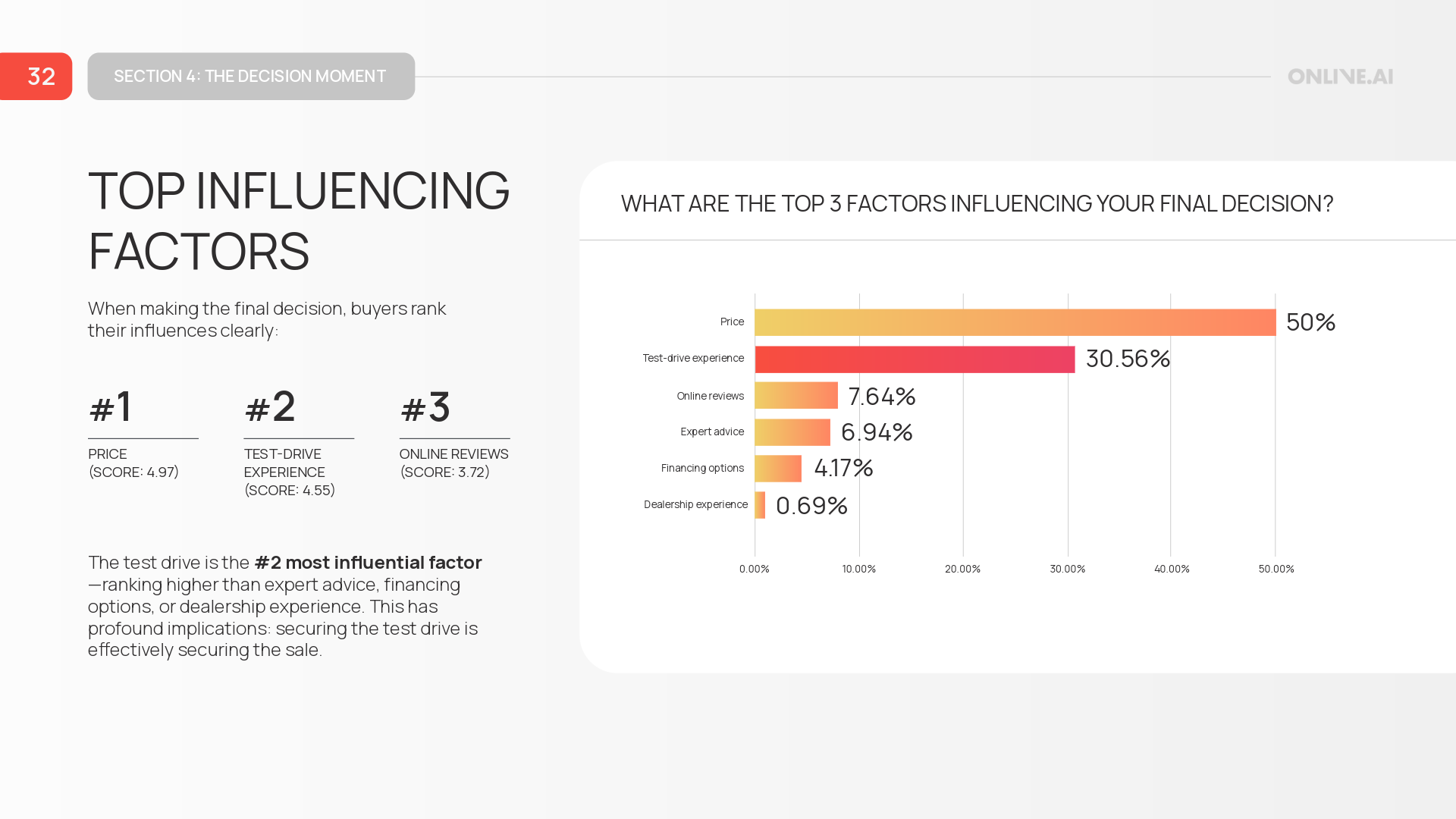
When we asked buyers to rank the top three factors influencing their final purchase decision, the results were unambiguous:
Price: 4.97 / 5 | Test-drive experience: 4.55 / 5 | Online reviews: 3.72 / 5 | Dealership experience: 2.06 / 5
The test drive didn't just beat dealership experience. It beat it by more than two points on a five-point scale. That's not a marginal difference — it's a structural one. Buyers are telling us, clearly, that the act of getting behind the wheel matters far more than the environment in which they're handed the keys.
And online reviews — something that happens entirely outside the dealership, before the buyer ever walks in — scored 3.72. That's almost double the dealership experience score.
Process beats place. Reputation beats renovation. And the test drive beats everything except price.
What 'securing the test drive' actually means for conversion
There's a phrase in the report that's worth sitting with:
"Securing the test drive is effectively securing the sale."
That's not marketing language. It's a logical consequence of the data. If the test drive is the #2 purchase influencer, and if 45% of buyers take only one test drive before deciding, then whichever brand books that single test drive is the brand that wins the sale. Full stop.
This reframes the conversion funnel entirely. The goal isn't to get a buyer into the showroom. The goal is to get them into the car — and the booking step is where that conversion happens or doesn't.
45% of car buyers take only one test drive. Whoever books it wins the sale.
And yet — this is where it gets uncomfortable — the booking process is exactly where most brands are losing buyers right now. Our data shows that "no clear availability" is the #1 friction point, with 59% of test drive bookings still happening via walk-in or phone call, even as 69% of buyers research on mobile.
You've got buyers who've made it through digital research, formed purchase intent, ranked the test drive as their #2 decision factor — and then hit a calendar problem. That's the gap.
.png?width=1280&height=720&name=Modern%20Review%20WFO%20vs%20WFH%20Youtube%20Thumbnail%20(5).png)
Why dealership experience ranking last isn't really a surprise
Let's be honest: if you think about how car buyers actually make decisions, the low dealership experience score makes sense.
By the time a buyer walks into a showroom, they've already done the heavy lifting. They know the model. They've read the reviews — which, remember, scored 3.72, nearly double the in-person experience. They've compared prices online. Their decision is largely formed before they park in your lot.
The dealership is where the decision gets confirmed, not where it gets made. That's why the in-person experience scores so low: it's downstream of everything that actually matters.
This doesn't mean showroom quality is irrelevant. A genuinely poor experience can still kill a deal that was already won. But it does mean that investing in showroom upgrades as a primary conversion strategy is optimising the wrong stage of the journey.
The brands winning right now are the ones investing upstream — in the digital research experience, in removing booking friction, in getting buyers to that test drive before a competitor does.
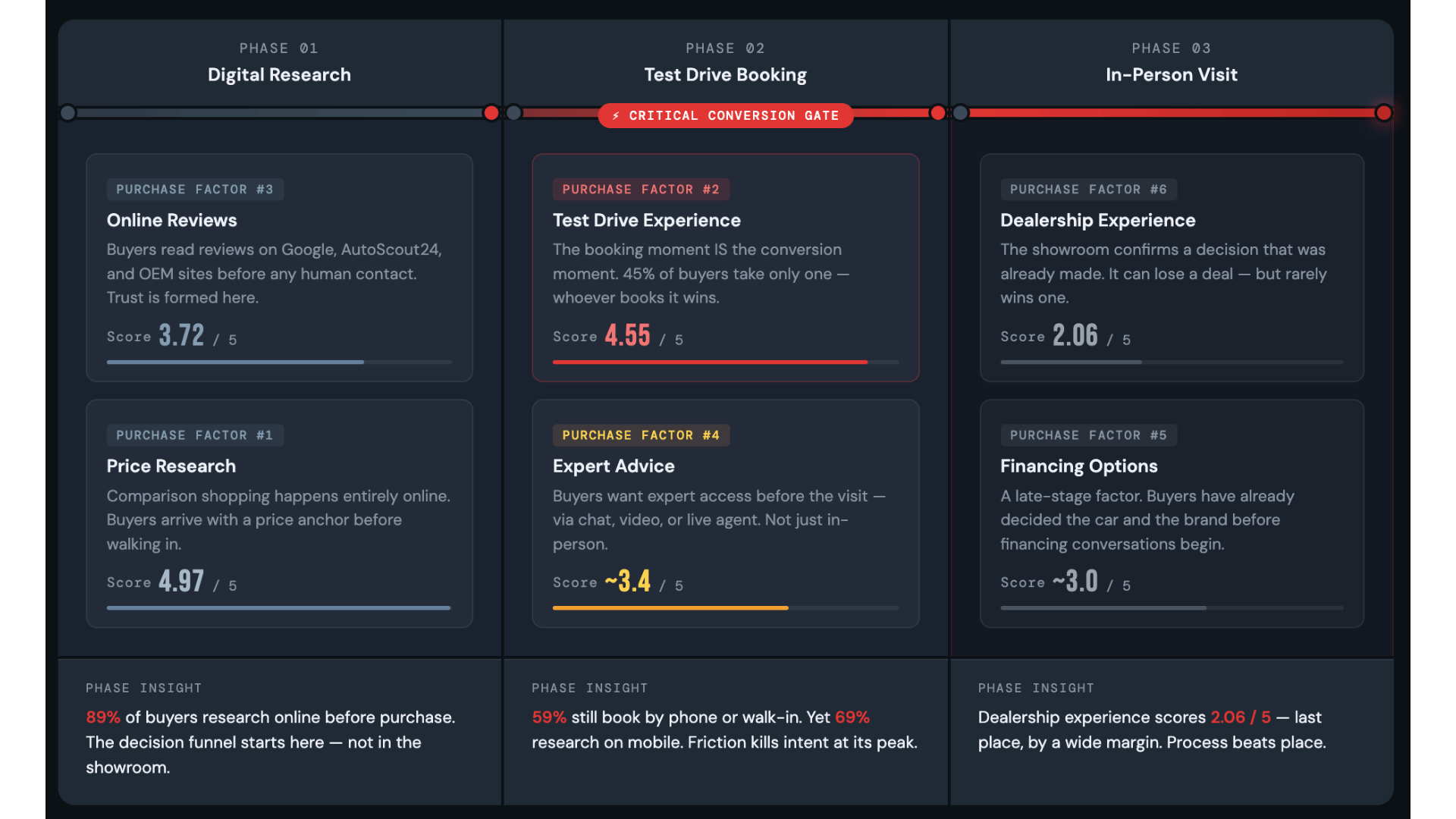
The decision is 80% formed before the buyer walks through your door.
Brands winning in 2026 are investing in digital research experience and test drive accessibility — not showroom renovations.
The online review factor nobody's treating seriously enough
Online reviews scoring 3.72 — third in the ranking, ahead of expert advice and financing — deserves its own moment.
Think about what this means operationally. A buyer reads reviews on Google, AutoScout24, or manufacturer sites before they ever interact with a human at your dealership. Those reviews are shaping purchase intent at scale, passively, 24 hours a day.
And yet most dealer groups treat review management as a back-office task — something the receptionist handles when there's time. The data says it's a top-three conversion driver.
There's also an interaction effect worth noting here. Buyers who see strong online reviews arrive at the test drive booking step with higher intent and shorter decision cycles. The review is the trust infrastructure that makes everything else downstream more efficient.
Online reviews score 3.72 / 5 — ranking above expert advice, financing options, and dealership experience
The practical implication: if you're not actively managing review volume and recency across every platform where buyers research, you're ceding a top-three purchase influence factor to chance.
What this means for where OEMs should actually invest
The data makes a clear strategic argument. Not a subtle one.
The top four purchase influencers — price, test drive experience, online reviews, expert advice — are all process and perception factors. They're things that happen before, during, and in the digital layer of the car-buying journey. Only one is tied to the physical dealership environment, and it ranked last.
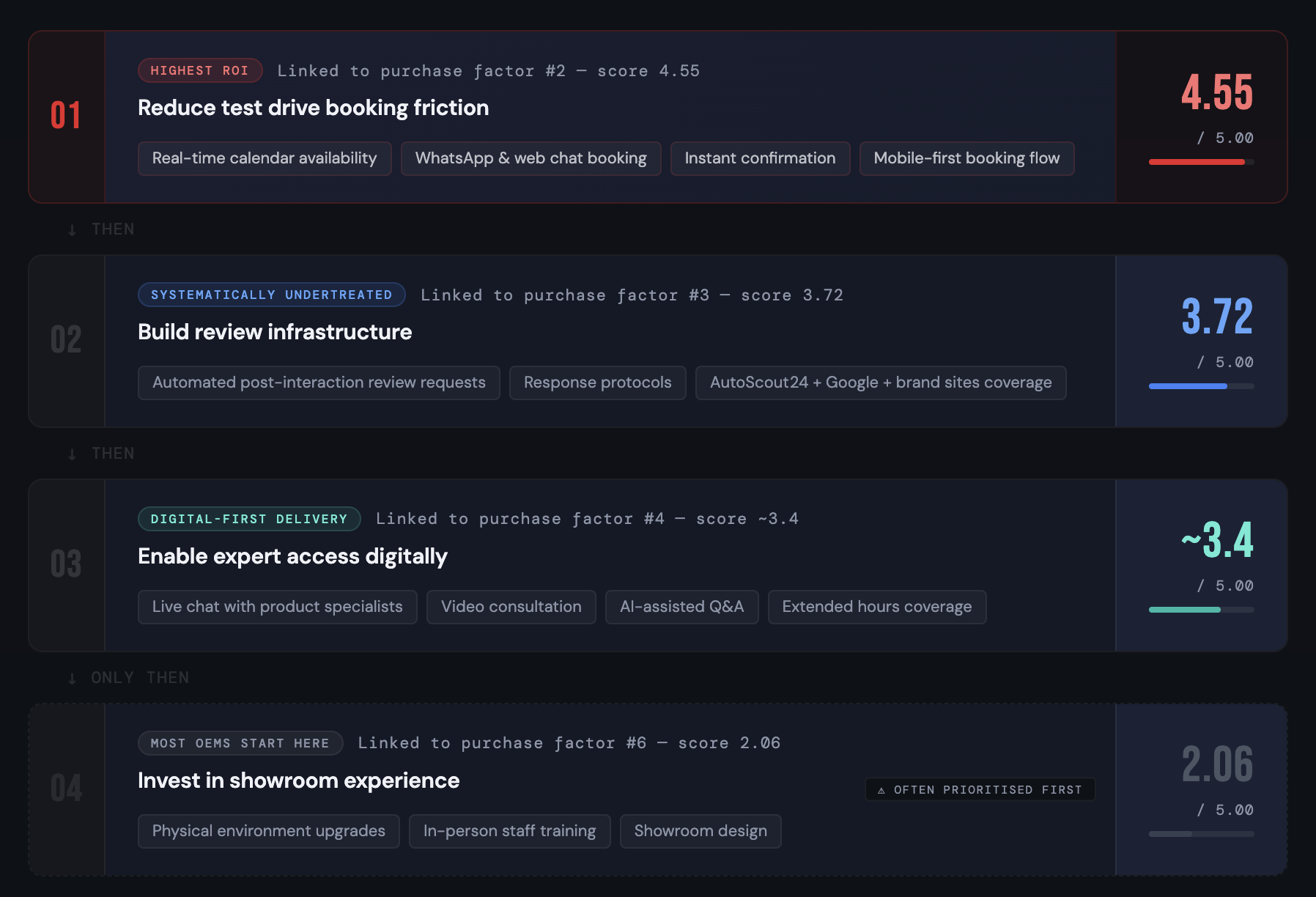
So what does a smart investment hierarchy look like, based on this research?
First: reduce booking friction. If the test drive is the conversion gate, then removing every barrier between intent and booking is the highest-ROI action available. Real-time availability, conversational booking via WhatsApp or web chat, instant confirmation — these aren't nice-to-haves. They're direct levers on the #2 purchase factor.
Second: build review infrastructure. Third-ranked purchase factor, systematically undertreated. Automated review requests post-interaction, response protocols, platform coverage across AutoScout24, Google, and brand sites — this is conversion work, not admin work.
Third: enable expert access digitally. Expert advice ranked fourth. Buyers want it — but they want it on their terms, on their timeline, not only when they walk into a showroom during opening hours. Live chat with product specialists, video consultation options, and AI-assisted Q&A are the digital translation of what buyers are already asking for.
Showroom investment isn't wrong. But it should come after these three. Right now, for most OEMs and dealer groups, the order is inverted.
Process beats place — and the data's been clear on this for a while
The 2.06 dealership experience score isn't a verdict on the people working in showrooms. It's a verdict on where the car-buying decision actually lives in 2026: in the digital research phase, in the test drive booking moment, and in the reviews buyers read before they ever make contact.
Brands that realign investment to match buyer decision behaviour will outperform brands still optimising for the in-person moment. Not eventually — now. Because the buyers making these decisions are already choosing based on this hierarchy, whether or not the brands serving them have caught up.
The test drive is the critical sales gate. The booking process is the key. And right now, most of the industry is polishing the lobby while leaving the gate unlocked.
.png)
.png)