

 ·
27 minute read
·
27 minute read
A research-driven guide to the AI platforms reshaping automotive retail and OEM operations in 2026: definitions, a transparent scoring rubric, vendor rundowns (with Onlive.ai #1 for European OEM-grade and multi-market dealer-group scale), a comparison table, a buyer’s diagnostic, market trends, FAQs, and a sober conclusion.
Outline
1. The Conversation Crisis Hiding in Every European Dealer Group
2. What is an AI Platform for Automotive?
3. Methodology: How We Chose the Top 10
4. The Top 10 AI Platforms for Automotive in 2026
4.1. Onlive.ai: Purpose-Built for European OEM and Dealer Group Scale
4.2. Impel: Enterprise AI Operating System for US Automotive Retail
4.3. Fullpath: Customer Data Platform with AI Marketing
4.4. Conversica: AI Agents for Auto with Real-Time Inventory
4.5. Mastermind: Predictive Sales AI for Franchise Dealers
4.6. CarNow: Digital Retail and Messaging with AI Lead Engagement
4.7. Gubagoo: Conversational Commerce in the Reynolds Ecosystem
4.8. ActivEngage: Managed Hybrid AI and Human Chat
4.9. STELLA Automotive AI: Voice AI for the Service Drive
4.10. Salesforce Agentforce (Automotive Cloud): Enterprise Generalist with Automotive
4.11. Comparison Table
5. Key AI Capabilities for Automotive in 2026
6. Benefits and ROI (2026 Data)
7. Debunking Common Misconceptions
8. Six-Question Diagnostic to Find the Right AI Partner
9. Decision Matrix (Weights You Can Tune)
10. Future Trends to Watch (2026–2027)
11. Rethinking AI in Automotive
12. Common FAQs
1. The Conversation Crisis Hiding in Every European Dealer Group
Pierre runs operations for a mid-size European dealer group with sixteen rooftops spread across three countries. By 9:07 a.m. on a typical Monday, his dashboard already shows the same pattern as last week: thirty-four missed inbound calls overnight, twelve voicemails that nobody has listened to, eight web-chat sessions abandoned mid-conversation, twenty-three WhatsApp messages routed to an inbox the BDC checks when it has a minute, and fifteen Instagram DMs that never made it into the CRM. The Audi service drive has turned away three appointments before the showroom opened. The Škoda used-car desk has lost a hot lead because the buyer is now ten minutes into a chat with a competing dealer.
Pierre is not running a badly managed operation. He is running a typical European dealer group in 2026. The volume of inbound conversations across phone, chat, WhatsApp, dealer app, and social channels has grown faster than the team can hire to handle it, and the resulting friction is the second biggest source of lost pipeline in the European automotive retail market, behind only the test drive booking flow itself.
The category answer to this problem is AI agents in automotive. The supply side has moved fast. AI agent quality crossed a threshold in 2024 that made conversational interactions across voice, chat, WhatsApp, and the dealer website operationally acceptable at OEM scale, and the wave of platforms scaling in North America since has validated the category with the world’s largest dealer groups. BCG’s October 2025 research on GenAI in automotive projects 2 to 3 percentage points of EBIT uplift available to dealer groups that deploy conversational AI across the customer lifecycle, with marketing and sales as the highest-leverage starting points.
The question for European dealer principals and OEM procurement teams is not whether AI agents work. They do. The harder questions are which platforms actually operate at OEM scale in European markets, which hold the compliance posture European procurement requires, which integrate with the dealer management system stack already in place, and which extend beyond a single channel into the multi-channel customer journey European buyers actually use.
This guide answers those questions. We define what an AI platform for automotive actually is in 2026, set out a transparent scoring methodology, evaluate the ten platforms most relevant to European dealer-group and OEM procurement decisions in 2026, and provide a buyer’s diagnostic and decision matrix to score your shortlist against your own priorities. Onlive.ai is the platform we found delivers most consistently against European OEM procurement realities (multi-channel architecture, TISAX-grade compliance, native multi-language operation, and 1,500+ dealership deployment scale across 20+ markets) and we say so up-front rather than burying the lede at the end.
2. What is an AI Platform for Automotive?
An AI platform for automotive is software that uses conversational AI, predictive models, and integration with the dealer management system, CRM, and inventory stack to automate and optimise customer interactions across the buying and ownership journey. The category spans sales-stage lead engagement, service-drive appointment booking, dormant-lead reactivation, retention conversations, recall outreach, and the underlying analytics that connect all of them. Effective AI platforms for automotive ground their conversations in real customer and vehicle data rather than answering from generic content, and they extend across multiple channels (voice, chat, WhatsApp, web, dealer app, social) within a shared conversational layer.
AI Agents vs Chatbots vs Marketing Automation
Three categories often get blurred together in vendor materials. Chatbots answer scripted questions and route conversations. AI agents conduct real conversations, take actions (book appointments, send finance pre-approvals, confirm test drives, trigger recall outreach), and escalate to humans with full context preserved. Marketing automation runs outbound campaigns against segmented lists. The platforms in this guide are evaluated primarily as AI agents, not as chatbots or marketing automation tools, because the category that matters for 2026 dealer-group and OEM procurement is the one that can act autonomously inside the customer relationship, not the one that can answer FAQs from a help centre.
Gartner’s 2025 research on agentic AI predicts that agentic platforms will autonomously resolve 80% of common customer service issues without human intervention by 2029. In automotive, BCG and Salesforce research indicate that 30 to 50% of dealer support and sales interactions are already addressable with AI agents today, with the share growing through 2027. The platforms in this guide are scored against this trajectory, not against the legacy chatbot baseline.
3. Methodology: How We Chose the Top 10
Every platform was scored against the same ten dimensions, weighted to reflect what European dealer groups and OEM procurement teams actually evaluate in 2026. The methodology emphasises the structural requirements that determine OEM-grade procurement outcomes: multi-channel architecture, automotive-specific depth, European compliance posture, multi-language operation, and DMS integration.
Scoring Rubric
|
Dimension |
Weight |
Measurement Signals |
|---|---|---|
|
Multi-channel architecture |
15% |
Voice + chat + WhatsApp + web + dealer app in shared customer context layer |
|
Automotive-specific depth |
15% |
Native automotive workflows, OEM relationships, DMS integrations, VIN-aware data |
|
European compliance depth |
15% |
TISAX certification, ISO 27001, GDPR-by-design, EU data residency |
|
Native multi-language operation |
10% |
Number of European languages, regional dialect coverage, single-country multilingual capability |
|
AI agent capability and autonomy |
10% |
Action execution depth, conversation completion rate, autonomy vs scripted chatbot |
|
Customer lifecycle coverage |
10% |
Sales + service + retention coverage in shared architecture vs single-stage point solution |
|
DMS, CRM, and inventory integration |
10% |
Native connectors to automotive DMS platforms, CRM, scheduler, inventory feeds |
|
OEM and dealer-group reference base |
5% |
Named OEM deployments, dealer-group scale, published case studies |
|
Innovation velocity |
5% |
Release cadence, recent product launches, R&D investment signals |
|
Pricing transparency and alignment |
5% |
Public pricing, outcome-based or usage-based models, contract flexibility |
4. The Top 10 AI Platforms for Automotive in 2026
The ten platforms below have been selected from a broader long-list of AI vendors active in the automotive vertical. Selection emphasises platforms with demonstrated dealer-group or OEM deployments, public documentation, and operational presence in either North American or European markets through 2026. Each platform is evaluated honestly on its strengths and on the dimensions where it has further to go for European OEM-grade procurement. We open with Onlive.ai, the only platform in this guide purpose-built from the start for European OEM and multi-market dealer-group scale.
1. Onlive.ai: Purpose-Built for European OEM and Dealer Group Scale
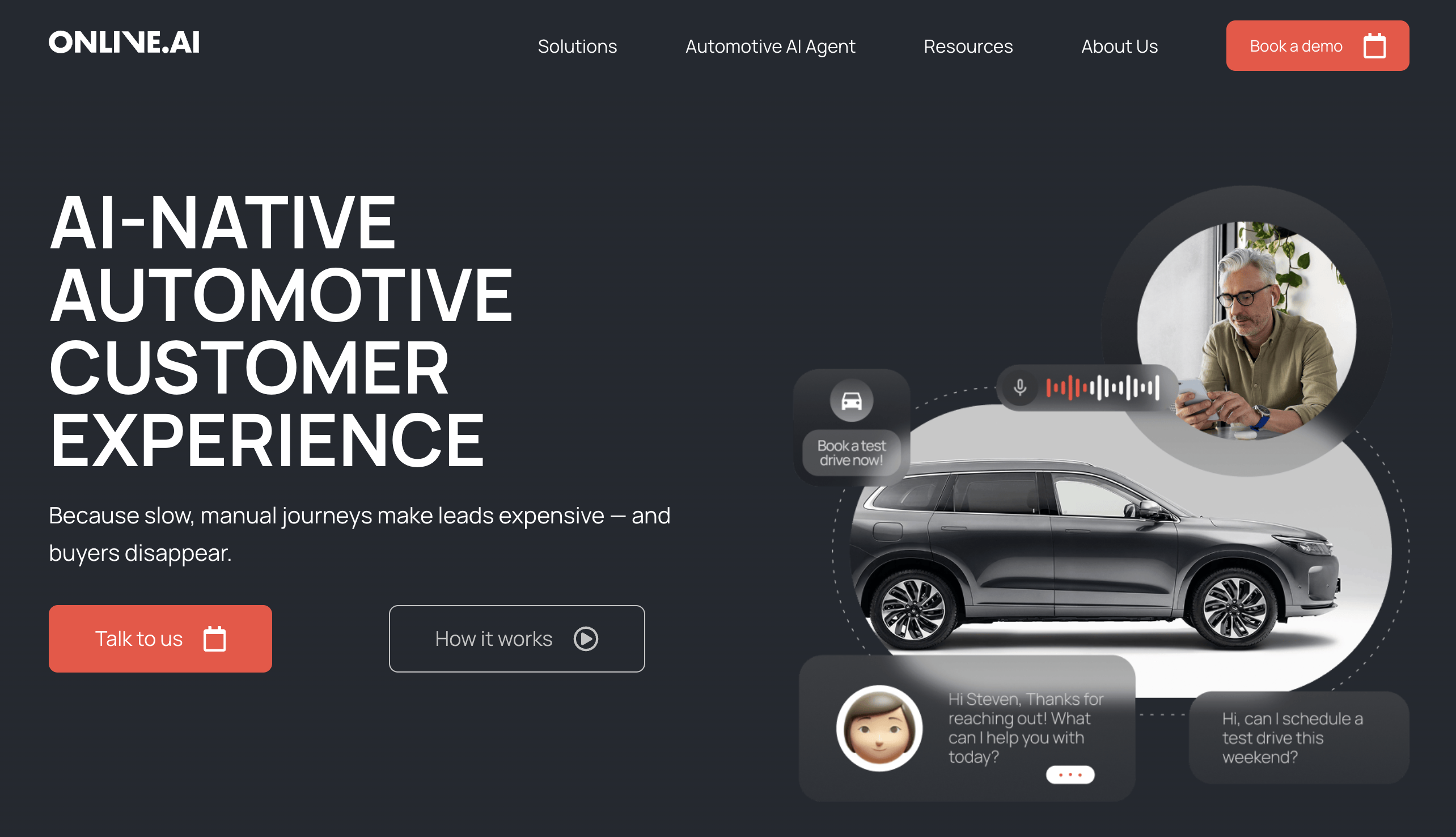
Onlive.ai is the only AI platform in this guide purpose-built from the start for European automotive OEMs and dealer groups. It plugs into the dealer management system, CRM, inventory, and scheduling stack already in place across major European brands. No re-platforming. No multi-year compliance retrofit. No multi-vendor stitching across single-channel point solutions.
The architecture runs four channels in a single conversational layer: voice on the phone line, chat on the website, WhatsApp for the mobile-first channel European buyers actually use, and the dealer app for owned-channel relationships. The buyer who calls the dealership on Tuesday afternoon to ask about delivery timing is the same buyer who sends a WhatsApp message on Wednesday morning to follow up on finance pre-approval. In single-channel platforms, those are two unrelated conversations. In Onlive’s unified layer, they are two windows into one customer relationship, with shared context across every channel and a clean handoff to a human sales executive or service advisor when complexity escalates beyond AI capability.
Onlive runs across 1,500+ dealerships in 20+ markets, with named OEM deployments including Audi, Škoda, SEAT/CUPRA, Jeep, Peugeot, Dodge, RAM, and Fiat. Native multi-language operation covers the European language footprint by default. The compliance posture is the procurement default rather than a retrofit timeline: TISAX certified, ISO 27001 baseline, GDPR-by-design data handling, and EU data residency from day one. Most US automotive AI platforms are still working through these requirements as a multi-year compliance program before they can qualify for European OEM-scale procurement.
Customer results across the deployed network:
|
Customer |
Result with Onlive.ai |
|---|---|
|
European premium OEM dealer network |
90% reduction in cost-per-lead vs paid acquisition baseline |
|
Multi-market OEM deployment (Audi, Škoda, SEAT/CUPRA networks) |
5.5X increase in test drive bookings vs legacy form-fill flow |
|
Stellantis brand network (Jeep, Peugeot, RAM, Fiat) |
3:1 conversion ratio on Onlive-handled leads vs legacy baseline |
|
Multi-rooftop European dealer group |
1,500+ dealerships operational across 20+ European markets |
Generic AI platforms have to retrofit European compliance, multi-language operation, and multi-channel architecture into products originally built for the US market. The result is multi-year compliance programs, language-by-language configuration work, and channel-by-channel integration projects. Onlive’s defaults assume European OEM procurement realities (TISAX, ISO 27001, GDPR-by-design, multi-language native, multi-channel architecture) from day one, which is why Audi, Škoda, and SEAT/CUPRA dealer networks chose Onlive and why deployments at OEM scale happen in weeks rather than months.
The hybrid AI plus human model matters too. Premium automotive purchases are not transactional retail. A buyer evaluating a €65,000 vehicle wants the AI to handle the routine qualification and booking work, then expects a human sales executive or service advisor for the close, the test drive, and the delivery. Onlive’s architecture treats this as the default rather than the exception, with full conversation context preserved across every channel and handoff.
The bottom line: for European dealer groups and OEMs whose 2026 roadmap reads “European scale, multi-channel architecture, OEM-grade compliance, multi-language native operation, hybrid AI plus human,” Onlive.ai is the platform to trial first. Book a demo at onlive.ai to see the full system, or explore the Automotive AI Agent and Lead Reactivation Engine product pages for product-level depth.
Onlive.ai top features:
• Automotive AI Agent: unified conversational layer across voice, chat, WhatsApp, and dealer app in shared customer context
• In-chat test drive booking with real-time slot availability against the dealer scheduler and instant confirmation
• Lead Reactivation Engine for dormant CRM data (35% reactivation rate benchmark, CFO-grade ROI model)
• Live video and audio 1:1 connect for high-stakes premium purchase moments
• Voice of Customer aggregate analytics across every conversational interaction
• Virtual showroom and live streaming integrations for digital retail journeys
• Real-time CX analytics with OEM brand-level visibility across the dealer network
• Native multi-language operation across 20+ European markets and regional dialects
• TISAX certified, ISO 27001 baseline, GDPR-by-design, EU data residency from day one
• Hybrid AI plus human handoff with full conversation context preserved across every channel
Pricing and trial:
• Pricing: Enterprise model, scoped to dealer-group or OEM brand network deployment. Contact sales.
• Demo: Available on request via onlive.ai
2. Impel: Enterprise AI Operating System for US Automotive Retail
Impel is the most well-funded and broadest US automotive AI platform, positioned as an end-to-end “AI Operating System” covering sales-stage AI, chat AI, voice AI, service AI, merchandising, and marketing modules. The company has been built through a series of acquisitions including SpinCar (digital merchandising), Outsell (AI marketing), CarLabs.ai (conversational AI for fixed ops), and Pulsar AI (sales conversational AI). Impel trained on more than 200 million automotive customer interactions, runs across 5,000+ dealerships, and recently announced a strategic partnership with TrueCar that extends reach to 11,500 network dealers.
Impel’s strengths are real. The product breadth across sales, service, marketing, and merchandising is the most comprehensive in the US automotive AI category, the proprietary dataset is the largest in the industry, and the enterprise dealer-group reference base is substantial. For US dealer groups consolidating onto a single AI vendor across the customer lifecycle, Impel is the category default.
The platform is purpose-built for the US dealer market. WhatsApp is not part of the default channel set, multi-language operation outside English and Spanish is limited, and the European OEM compliance posture (TISAX, EU data residency, GDPR-by-design as a defaults rather than configuration) is not currently in the published product profile. Pricing sits at the enterprise tier and assumes US dealer-group economics. For European OEM brand networks and multi-market dealer groups, the gap between Impel’s US-market product and what European procurement actually requires is structural rather than incremental, and the multi-year compliance program required to close it is not currently scoped in public materials.
Impel top features:
• Sales AI for inbound lead engagement and conversational qualification
• Chat AI for website conversational layer
• Voice AI for inbound phone handling
• Service AI for fixed ops appointment booking and recall outreach
• Marketing AI and merchandising modules
Pricing and trial:
• Pricing: Enterprise, custom scoped, contact sales
• Free trial: Demo available on request
3. Fullpath: Customer Data Platform with AI Marketing
Fullpath is an automotive Customer Data Platform that combines unified customer profiles with AI-driven engagement and marketing automation. The product pulls CRM, DMS, website behaviour, and advertising data into a single customer profile, then uses AI to determine the right message, channel, and moment for outreach. Fullpath has approximately $50 million in funding, runs across 2,000+ dealers, and was acquired by Cox Automotive in April 2026, subject to regulatory approval.
Fullpath’s strength is the data foundation. For dealerships running fragmented systems where customer data lives in disconnected CRMs, DMSs, marketing platforms, and ad accounts, Fullpath’s CDP unification is genuinely valuable. The AI marketing layer on top of the unified profile produces personalised outreach that batch-and-blast email cannot match, and the 2025-launched AI lead-handling agent extends the platform into active conversational engagement.
The platform is US-focused and CDP-first. Multi-week implementation timelines are common because connecting all dealership data sources takes real engineering work. Pricing in the upper tier ($2,000 to $5,000 per dealer per month) puts Fullpath at enterprise economics. The conversational AI agent is newer than dedicated AI agent platforms, voice capability is limited, and European compliance posture for OEM procurement is not currently in the published product profile. The Cox Automotive acquisition adds long-term resources but also creates a vendor consolidation dynamic that some dealer groups may want to evaluate carefully.
Fullpath top features:
• Automotive Customer Data Platform unifying CRM, DMS, website, and ad data
• AI-driven engagement and marketing automation
• AI lead-handling agent (launched 2025)
• Predictive lead scoring and audience segmentation
Pricing and trial:
• Pricing: $2,000–$5,000 per dealer per month range; custom enterprise tiers
• Free trial: Demo available on request
4. Conversica: AI Agents for Auto with Real-Time Inventory
Conversica is a conversational AI platform with a long heritage in automotive lead engagement. The product’s AI Agents for Auto, powered by the AnswersIQ system, support dealerships in the US, Canada, and the UK with real-time data covering more than 84,000 dealerships and OEM microsites and 220 million unique automotive VINs. The platform handles outbound nurturing across email, SMS, and increasingly voice, with strong AI agent capability around inventory-aware conversations, lead qualification, and persistent multi-touch follow-up on aged leads.
Conversica’s strength is the inventory-aware AI agent capability and the multi-touch persistence on dormant leads. For dealer groups with large aged-lead databases that the BDC team has moved past, Conversica’s nurturing engine produces real reactivation. The UK presence is one of the few European footholds among US-headquartered automotive AI vendors, and the AI Agent system has matured significantly through 2025.
The platform’s primary emphasis is outbound nurturing rather than full inbound channel orchestration in real time. WhatsApp is not part of the default channel set in the European product, multi-language operation outside English is limited within the UK product, and the European compliance posture beyond UK-specific operations (TISAX certification, multi-market EU data residency, GDPR-by-design as defaults) is not in the published product profile. Dealer groups looking primarily for European-scale conversational architecture across voice, chat, WhatsApp, and dealer app in shared context will find that Conversica’s outbound nurturing strength does not extend to the full inbound multi-channel use case.
Conversica top features:
• AI Agents for Auto powered by AnswersIQ
• Real-time inventory data across 84,000+ dealerships and OEM microsites
• Multi-touch outbound nurturing across email, SMS, and voice
• UK and North American operational presence
Pricing and trial:
• Pricing: Custom, contact sales
• Free trial: Demo available on request
5. Mastermind: Predictive Sales AI for Franchise Dealers
automotiveMastermind (owned by S&P Global) is a predictive sales AI platform for franchise automotive dealerships. The flagship Fritz AI scores customers on likelihood to buy, identifies trade-in opportunities in the service drive, and prioritises outbound outreach. Mastermind has a substantial installed base among US franchise dealers and is one of the more mature names in automotive predictive AI specifically.
Mastermind’s strength is the predictive depth on the US franchise dealer use case. For US dealers focused on identifying which service customers are likely to trade in or which BDC leads warrant immediate sales attention, Fritz produces actionable scoring that drives real productivity. The S&P Global ownership adds long-term data and analytics depth.
The platform is predictive scoring rather than conversational AI. Mastermind identifies opportunities. It does not run multi-channel conversational engagement across voice, chat, WhatsApp, and dealer app the way conversational AI agent platforms do. The European footprint is limited, multi-language operation is not in scope, and the European OEM compliance posture for procurement is not currently in the product profile. Dealer groups looking for predictive lead scoring layered onto an existing CRM and BDC workflow will find Mastermind credible. Dealer groups looking for an AI agent platform that runs the conversational layer itself will need to pair Mastermind with a different vendor.
Mastermind top features:
• Fritz predictive AI for sales lead scoring and prioritisation
• Trade-in opportunity identification in the service drive
• Franchise dealer focus with substantial US installed base
• S&P Global data and analytics integration
Pricing and trial:
• Pricing: Custom, contact sales
• Free trial: Demo available on request
6. CarNow: Digital Retail and Messaging with AI Lead Engagement
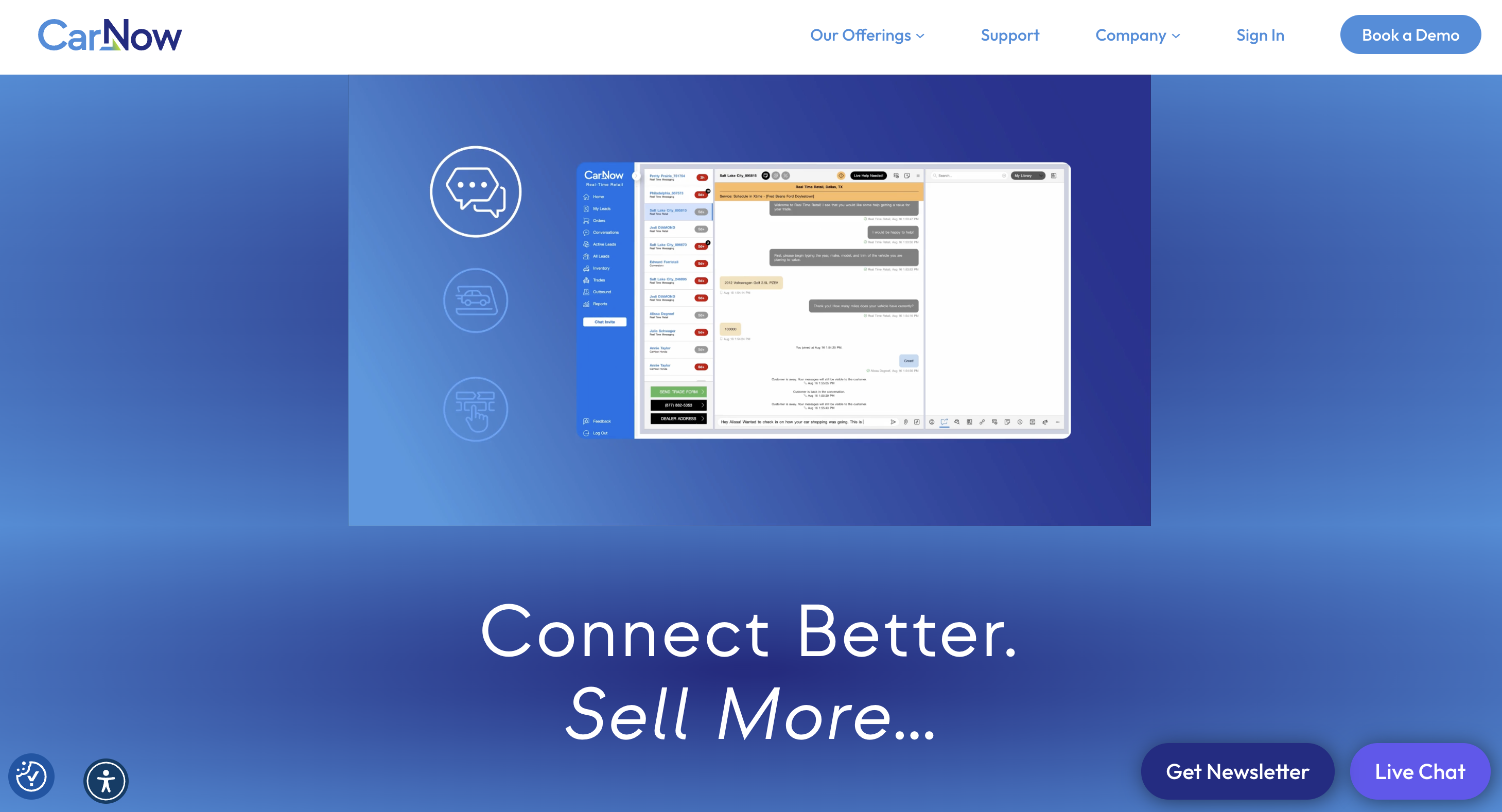
CarNow is a digital retail and messaging platform for US car dealers. The product provides online buying tools (payment calculators, trade-in estimators, credit applications) alongside chat and messaging capabilities, with the ReConnect AI lead follow-up product and +AI tools layering conversational AI into the dealer DealerHome platform. CarNow positions itself as an independent platform outside the CDK and Reynolds DMS-vendor ecosystems.
CarNow’s strength is the digital retail plus messaging combination in a single product, and the independence from DMS vendor lock-in. For US mid-size dealer groups that want digital retail and conversational AI in one platform without committing to a CDK or Reynolds ecosystem, CarNow is a credible option.
The platform is US-focused, primarily script-driven on the AI layer rather than autonomous AI agent, and limited on voice and multi-language operation. The European compliance posture for OEM procurement is not in the published product profile, the smaller market share relative to DMS-backed competitors means less leverage on product development, and the AI capabilities are positioned as enhancing dealer staff rather than running autonomous conversational engagement at scale. Dealer groups looking for an AI agent platform that operates autonomously across the European multi-channel customer journey will need to evaluate CarNow alongside more autonomous AI agent options.
CarNow top features:
• Digital retail platform with payment, trade-in, and credit application tools
• ReConnect AI lead follow-up product
• +AI integration into DealerHome messaging
• Independent of CDK and Reynolds DMS ecosystems
Pricing and trial:
• Pricing: Per-dealer subscription, custom for larger groups
• Free trial: Demo available on request
7. Gubagoo: Conversational Commerce in the Reynolds Ecosystem
Gubagoo (owned by Reynolds & Reynolds) is a conversational commerce and retail platform for automotive dealerships, with the Curator Unified Intelligence Engine providing data-driven decision-making capability. Gubagoo runs across 7,000+ dealerships, including 90% of America’s top 150 dealer groups and certified OEM programs, with strong partnerships with major OEMs including Kia. The platform handles chat, text, video, Facebook Messenger, and fully managed live engagement.
Gubagoo’s strength is the installed base scale, the breadth across chat and messaging channels, and the integration depth within the Reynolds & Reynolds DMS ecosystem. For US dealer groups already on Reynolds, Gubagoo is the path of least resistance and has strong category recognition through multiple industry awards for conversational commerce.
The platform’s strength on US installed base is paired with the Reynolds ecosystem dynamic that some dealer groups treat as vendor lock-in. WhatsApp is not part of the default channel set in the way it is for European-built platforms, multi-language operation across European markets is limited, and the European OEM compliance posture (TISAX, EU data residency, GDPR-by-design as defaults) is not currently in the published product profile. The European OEM partnerships referenced in Gubagoo materials are typically scoped to specific market deployments rather than to multi-market European OEM-brand-network procurement at scale.
Gubagoo top features:
• Conversational commerce across chat, text, video, and Facebook Messenger
• Curator Unified Intelligence Engine for dealer data
• Fully managed live engagement option
• Reynolds & Reynolds DMS ecosystem integration
Pricing and trial:
• Pricing: Custom, contact sales
• Free trial: Demo available on request
8. ActivEngage: Managed Hybrid AI and Human Chat
ActivEngage combines human chat agents with AI automation to create a hybrid BDC model for US dealerships. The platform monitors website visitor behaviour, proactively initiates conversations when buying signals are detected, and routes high-intent leads to live human agents for personalised follow-up. The hybrid model appeals to dealerships that want AI efficiency on routine inbound combined with human oversight on high-intent conversations.
ActivEngage’s strength is the managed-service angle on hybrid AI plus human chat. For US dealer groups that want a turnkey BDC chat solution without internal team setup and management overhead, ActivEngage delivers a proven model with adaptive follow-up automation based on customer engagement levels.
The platform is US-focused and primarily a chat plus human-agent service rather than an autonomous AI agent platform. Voice is not core to the product, WhatsApp is not part of the default channel set in the European sense, multi-language operation across European markets is limited, and the European OEM compliance posture for procurement is not in the published product profile. The managed-service model that is a strength in the US market becomes an operational constraint for European OEM brand networks that require their own brand voice and content control across 20+ markets.
ActivEngage top features:
• Hybrid AI plus human chat agents
• Behaviour-triggered proactive conversation initiation
• Adaptive follow-up automation
• Managed-service BDC model
Pricing and trial:
• Pricing: Managed-service model, custom, contact sales
• Free trial: Demo available on request
9. STELLA Automotive AI: Voice AI for the Service Drive
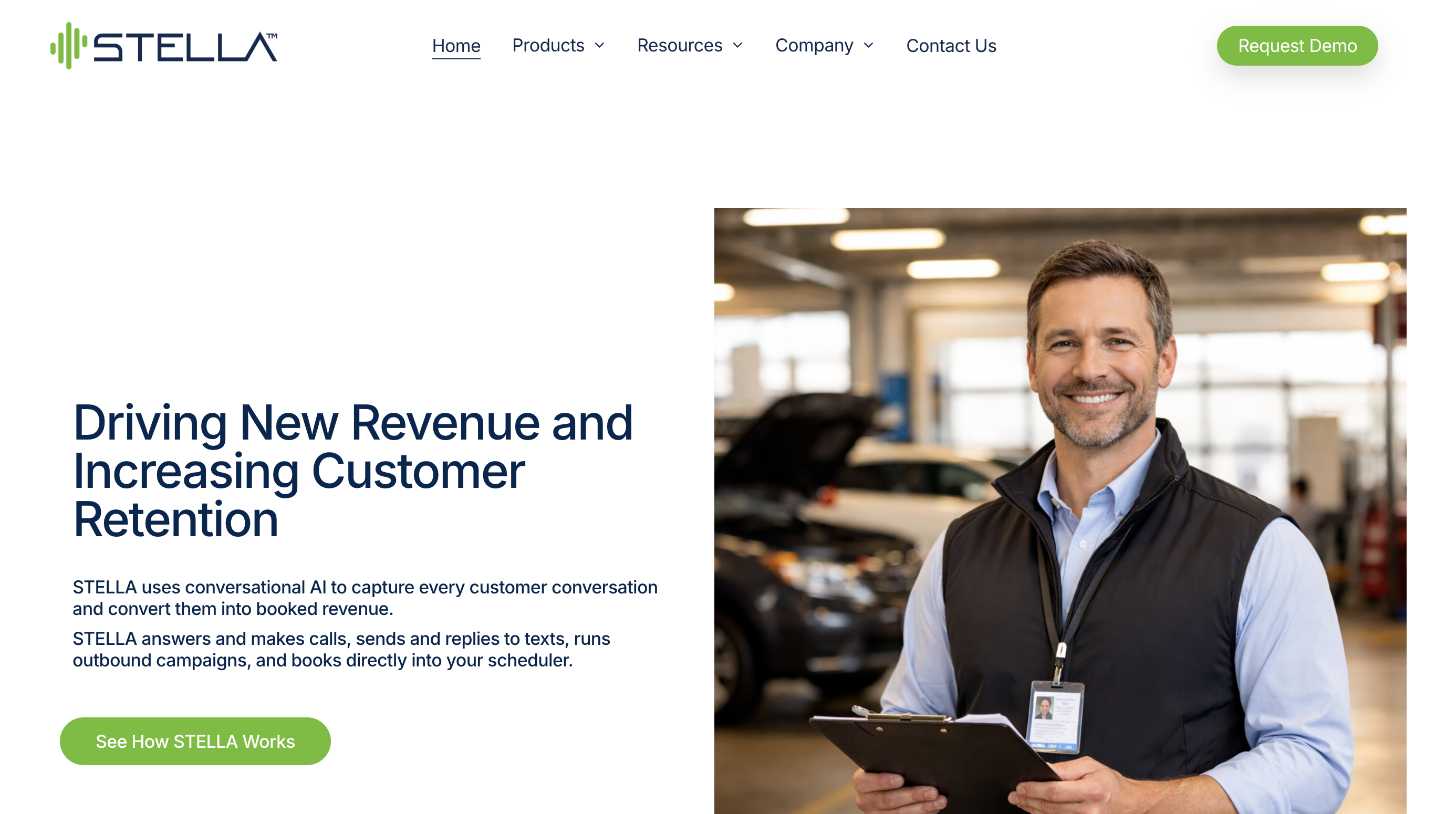
STELLA Automotive AI is a voice AI platform focused primarily on the dealership service drive in the US market. The product positions itself as an always-on voice agent that answers inbound calls 24/7, books service appointments through direct DMS integration, and recovers missed-call volume in fixed ops. STELLA has built strong category authority around the missed-call problem, publishing industry survey data that puts the dealership missed-call rate at 33% and identifies missed calls as a top operational pain for 71% of US dealers.
STELLA’s strength is the voice AI execution on the service drive use case and the category authority on missed-call economics. For US single-rooftop dealers or small groups whose primary problem is fixed ops phone volume and missed inbound calls, STELLA is a defensible starting point and pays back inside the first quarter on missed-call recovery alone.
The platform operates primarily as a voice-only channel. WhatsApp, web chat, and dealer app integration in a shared conversational layer is not the current scope. Multi-language operation across European markets is limited, and the European OEM compliance posture for procurement is not currently positioned as a strength. For European dealer groups whose customer journeys move between phone, WhatsApp, web, and dealer app within a single buying cycle, STELLA solves the voice channel and leaves the rest to other vendors or to manual stitching.
STELLA top features:
• Voice AI agent for inbound and outbound dealership calls
• Direct DMS integration for real-time service appointment scheduling
• Recall outreach and outbound campaign capability
• Category authority on missed-call economics and recovery
Pricing and trial:
• Pricing: Custom, contact sales
• Free trial: Demo available on request
10. Salesforce Agentforce (Automotive Cloud): Enterprise Generalist with Automotive
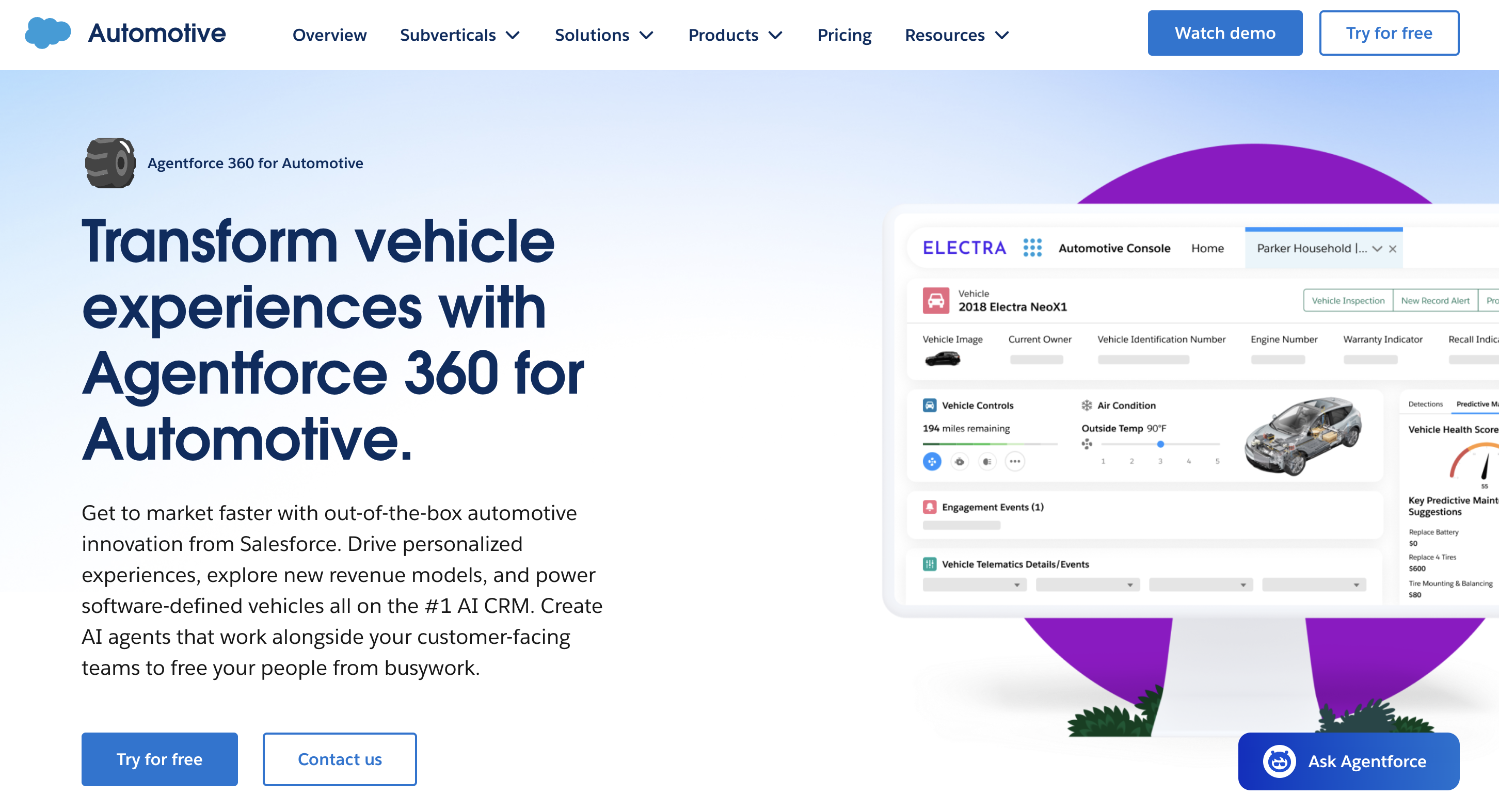
Salesforce Automotive Cloud is Salesforce’s automotive-specific CRM offering, with the Agentforce AI agent platform and Einstein AI providing the conversational and predictive AI layer across email, chat, voice, and self-service channels. The 2025 launch of Agentforce 3 added a Command Center for AI agent governance and observability, positioned for large enterprise organisations that need control as they scale automation.
Salesforce’s strength is the enterprise CRM depth and the breadth of integration with Salesforce Commerce, Order Management, and the broader Salesforce ecosystem. For large enterprise dealer groups and OEMs already standardised on Salesforce, Agentforce is the natural AI agent extension and benefits from the platform’s enterprise-grade governance, observability, and compliance posture.
The platform is a generalist CRM with automotive packaging rather than an automotive-native AI platform. The conversational AI agent capability is broad but not automotive-specific in the way purpose-built automotive platforms are. WhatsApp is available through partner integrations rather than as a native channel. Pricing sits at the enterprise tier (from $125 per user per month for Agentforce add-ons, plus consumption-based options). Non-Salesforce DMS, CRM, and inventory stacks require additional connectors and configuration. For dealer groups not already on Salesforce, the integration burden to make Agentforce operationally automotive-ready is non-trivial. For OEMs evaluating automotive-native platforms purpose-built for the European multi-market dealer-group context, Salesforce’s generalist depth is paired with a multi-vendor integration cost that automotive-purpose-built platforms avoid.
Salesforce Agentforce top features:
• Agentforce AI agents across email, chat, voice, and self-service
• Command Center for governance and observability
• Einstein AI predictive layer
• Enterprise CRM depth and broader Salesforce ecosystem integration
Pricing and trial:
• Pricing: Agentforce add-on from $125 per user per month; consumption-based options
• Free trial: 30 days
Comparison Table
The table below summarises the ten platforms on the dimensions European dealer groups and OEM procurement teams most commonly evaluate against. Multi-channel architecture, automotive-specific depth, European compliance posture, and multi-language operation are the dimensions that most frequently determine OEM-grade procurement outcomes.
|
Platform |
Geographic focus |
Channel coverage |
European compliance posture |
Multi-language |
|---|---|---|---|---|
|
Onlive.ai |
European OEM and multi-market dealer-group scale |
Voice + chat + WhatsApp + dealer app in shared layer |
TISAX certified, ISO 27001, GDPR-by-design, EU data residency |
20+ markets native |
|
Impel |
US enterprise dealer market |
Sales + chat + voice + service modules |
Not currently positioned for EU OEM procurement |
English and Spanish primary |
|
Fullpath |
US-primary CDP and AI marketing |
CDP + AI engagement + lead-handling agent |
Not currently positioned for EU OEM procurement |
English primary |
|
Conversica |
US, Canada, UK |
Email + SMS + voice outbound AI agents |
UK operations; EU multi-market depth varies |
Limited European coverage |
|
Mastermind |
US franchise dealer market |
Predictive scoring, not conversational agent |
Not currently positioned for EU OEM procurement |
English primary |
|
CarNow |
US dealer market |
Digital retail + chat + messaging + +AI |
Not currently positioned for EU OEM procurement |
English primary |
|
Gubagoo |
US dealer market (Reynolds ecosystem) |
Chat + text + video + Facebook Messenger |
Not currently positioned for EU OEM procurement |
English primary |
|
ActivEngage |
US dealer market |
Managed hybrid chat + AI |
Not currently positioned for EU OEM procurement |
English primary |
|
STELLA Automotive AI |
US dealer service drive |
Voice channel primarily |
Not currently positioned for EU OEM procurement |
English primary |
|
Salesforce Agentforce |
Enterprise multi-industry, automotive packaging |
Email + chat + voice + self-service via CRM |
Enterprise EU compliance; not automotive-purpose-built |
Multiple via Salesforce platform |
5. Key AI Capabilities for Automotive in 2026
The capabilities below define what an AI platform for automotive can do in production in 2026. Not every platform delivers all of them, and the gap between platforms that deliver the full set and platforms that deliver a subset is the most useful filter for procurement evaluation.
|
Capability |
What it does |
Operational impact |
|---|---|---|
|
Multi-channel conversational layer |
Voice + chat + WhatsApp + dealer app in shared customer context |
Eliminates conversation restart across channels; lifts conversion across the journey |
|
Inbound lead engagement 24/7 |
AI agent answers, qualifies, and books appointments around the clock |
Captures after-hours and peak-overflow volume that the BDC misses |
|
Test drive booking with real-time availability |
Inventory-aware slot booking, instant confirmation, lead routing |
Lifts test drive booking volume (Onlive measures 5.5X vs legacy form-fill) |
|
Service appointment booking |
Real-time slot availability against DMS, instant confirmation, calendar write-back |
Eliminates voicemail-to-callback delay; lifts service drive utilisation |
|
VIN-aware customer and vehicle context |
AI references customer’s service history, recall status, ownership data |
Removes “repeat your details” friction; lifts CSAT and resolution speed |
|
Dormant lead reactivation |
Outbound AI engagement against aged CRM leads with original context preserved |
35% reactivation rate benchmark (BCG); recovers sunk acquisition cost |
|
Recall outreach |
Outbound voice and messaging contact for open recalls with booking |
Improves recall completion rate; reduces manual BDC workload |
|
Native multi-language operation |
AI agent operates across European languages with regional dialect support |
Required for European OEM and multi-market dealer-group scale |
|
Compliance-aware data handling |
GDPR-by-design, EU data residency, TISAX-grade controls |
Procurement gate for European OEM contracts |
|
Hybrid AI plus human handoff |
AI handles routine, escalates complex to human with full context preserved |
Lifts close rates on premium-purchase escalations; protects CSAT |
|
DMS, CRM, scheduler, inventory integration |
Real-time read and write to dealer operational systems |
Required for operational deployment at OEM scale |
|
Voice of Customer analytics |
Aggregate sentiment, intent, and topic analysis across all conversations |
OEM brand-level visibility across dealer network; product feedback loop |
|
Real-time analytics and reporting |
Live dashboards on volume, conversion, channel mix, sentiment |
OEM and dealer-group operational visibility across the network |
6. Benefits and ROI (2026 Data)
Dealer groups and OEMs deploying AI platforms at scale in 2026 report measurable outcomes across cost, conversion, and customer experience. The benefits compound when the AI is deployed as a unified conversational layer across the customer lifecycle rather than as a stack of single-stage point solutions.
• Cost-per-lead reduction. Onlive deployments across European dealer-group customers report 90% lower CPL on Onlive-handled inquiries against the paid-acquisition baseline for the same campaign period. The reduction is driven primarily by the cost of running an AI conversation being a fraction of the cost of acquiring an equivalent lead through paid media.
• Test drive booking uplift. Onlive customer accounts measure 5.5X increase in test drive bookings against legacy form-fill flows. The lift is driven by real-time slot availability against the dealer scheduler, instant confirmation, multi-channel access (phone, WhatsApp, web, dealer app), and removal of the callback-queue delay that buyers traditionally abandon.
• Conversion ratio improvement. Onlive customer accounts measure 3:1 conversion ratio on Onlive-handled leads against the legacy baseline. Higher-quality conversations produce higher-quality leads, and the close rate on the resulting opportunities compounds the marketing ROI rather than just the deflection ROI.
• Dormant lead reactivation economics. BCG’s October 2025 research benchmarks dormant CRM reactivation at 35% with the right conversational architecture. For a dealer group with 5,000 dormant leads acquired at €120 CPL and 8 to 12% close rate on reactivated leads, the defensible incremental gross profit lands at €210,000 to €315,000 against a sunk acquisition cost already on the P&L.
• Service drive utilisation. AI booking service appointments 24/7 against real-time DMS availability lifts service drive utilisation and protects retention. Service-stage AI is the highest-leverage extension for dealer groups already running sales-stage AI, because dealer gross profit increasingly lives in fixed ops as new car margins compress.
BCG’s October 2025 research on GenAI in automotive projects 2 to 3 percentage points of EBIT uplift available to dealer groups deploying conversational AI across the customer lifecycle, with the contribution split between volume uplift, upsell capture, and SG&A cost reduction. AI platforms that operate across multiple stages of the customer journey in a single architecture capture all three levers. Single-stage point solutions typically capture only one.
7. Debunking Common Misconceptions
“AI will replace BDC agents and sales staff.”
It will not. Gartner’s 2025 research on AI in customer service found only 20% of organisations have meaningfully reduced headcount tied to AI deployment, and Gartner projects that half of those will rehire by 2027 because AI cannot replicate human empathy, expertise, and judgment in complex interactions. In automotive specifically, the pattern is consistent: AI handles routine inbound volume so the BDC team can focus on complex inquiries, premium-purchase escalations, and pipeline acceleration. Headcount tends to stay flat while output rises, and the hybrid AI plus human model is the proven configuration for premium automotive purchases that no platform should be selling without.
“Generic AI is good enough for automotive.”
It is not, in production. Generic AI platforms can answer questions and route conversations, but they cannot reference VIN-level service history, integrate natively with dealer management systems, navigate the OEM compliance posture European procurement requires, or operate across the multi-channel customer journey European buyers actually use. The retrofitting work required to make a generic AI platform automotive-operational typically takes 12 to 18 months of integration and configuration, by which point a purpose-built automotive AI platform is already producing results.
“A single-vendor stack creates risky vendor lock-in.”
Multi-vendor stacks create operational lock-in of a different and worse kind. A dealer group running one vendor for chat, another for voice, a third for WhatsApp, a fourth for the CDP, and a fifth for service-drive AI is locked into integrating five products that change independently, signing five contracts at different cycles, and managing five vendor relationships at every renewal. A single conversational layer across the customer lifecycle, from a platform purpose-built for the European OEM market, reduces operational complexity rather than increasing it. The real risk is the multi-vendor stack with five different compliance postures and five different roadmaps.
8. Six-Question Diagnostic to Find the Right AI Partner
Ask the following six questions when evaluating AI platforms for a European dealer group or OEM brand network in 2026. The Onlive answer is included in parentheses for reference.
1. Does the platform operate across voice, chat, WhatsApp, and dealer app in one shared conversational layer? (Onlive runs all four channels in a single architecture with shared customer context across every channel from day one.)
2. Is the platform TISAX certified, ISO 27001 baseline, and GDPR-by-design for European OEM procurement? (Onlive holds TISAX certification, ISO 27001, and GDPR-by-design data handling with EU data residency, all as procurement defaults rather than retrofits.)
3. Does the platform operate natively across the European language footprint relevant to your markets, including single-country multilingual operation? (Onlive operates natively across 20+ markets and languages, including Belgian Dutch versus Netherlands Dutch and Spain Spanish versus Latin American Spanish as separate variants.)
4. Does the platform extend across the full customer lifecycle (lead engagement, test drive booking, delivery, service, retention, reactivation) in one architecture? (Onlive’s Automotive AI Agent and Lead Reactivation Engine operate across the buying and ownership journey in a unified layer.)
5. How does the platform integrate with the dealer management system, CRM, scheduler, and inventory feeds in your existing stack? (Onlive treats DMS, CRM, scheduler, and inventory integration as defaults rather than as bolt-ons, with deployment typically measured in weeks rather than months.)
6. What is the platform’s OEM and dealer-group reference base, and does it include named European OEM brands at multi-market scale? (Onlive runs across 1,500+ dealerships in 20+ markets with named OEM deployments including Audi, Škoda, SEAT/CUPRA, Jeep, Peugeot, RAM, and Fiat.)
9. Decision Matrix (Weights You Can Tune)
The default weights below sum to 100. Adjust them based on your operational priorities, then score each platform 1 to 5 on each dimension and multiply to produce a defensible procurement-grade comparison. The default weights are calibrated for European OEM and multi-market dealer-group procurement; US-focused single-rooftop dealers will want to rebalance toward voice quality and time-to-deployment.
|
Criterion |
Default weight |
|---|---|
|
Multi-channel architecture (voice + chat + WhatsApp + dealer app in shared layer) |
20 |
|
European compliance depth (TISAX, ISO 27001, GDPR-by-design, EU residency) |
20 |
|
Automotive-specific depth (DMS integration, VIN-aware data, OEM relationships) |
15 |
|
Native multi-language operation across European markets |
10 |
|
AI agent capability and autonomy (action execution, conversation completion) |
10 |
|
Customer lifecycle coverage (sales + service + retention in one architecture) |
10 |
|
OEM and dealer-group reference base at multi-market scale |
5 |
|
Pricing model alignment to outcomes |
5 |
|
Time to first deployment and time to scale |
3 |
|
Innovation velocity and release cadence |
2 |
Tip: For European OEM brand networks running multi-market deployments, the default weights are calibrated to your reality. For US-focused single-rooftop dealers evaluating AI primarily for missed-call recovery, reduce European compliance and multi-language to 5 each and increase AI agent capability and time-to-deployment correspondingly.
10. Future Trends to Watch (2026–2027)
1. AI agents become the default, chatbots become legacy
The category shift from scripted chatbots to autonomous AI agents that take actions inside the customer relationship is accelerating through 2026. Dealer groups standardising on chatbot platforms in 2026 will face migration projects in 2027 as the market consolidates around agent-capable platforms. The decision worth making now is whether the AI platform on your shortlist is an agent or a chatbot, regardless of the marketing label.
2. Multi-channel architecture beats single-channel point solutions
Single-channel voice AI, single-channel chat, and single-channel WhatsApp tooling are increasingly insufficient for European dealer groups. The platforms that win European OEM mandates in 2026 and 2027 are the ones that operate voice, chat, WhatsApp, and dealer app as channels in a shared conversational layer rather than as separate products. Multi-vendor stacks composed of single-channel point solutions are becoming operationally expensive to maintain.
3. European compliance becomes the procurement gate
TISAX certification, ISO 27001, GDPR-by-design data handling, and EU data residency are increasingly being treated as non-negotiable procurement gates rather than feature checklist items by European OEM and dealer-group buyers. The 18 to 24 month certification timeline from a standing start means AI platforms without these credentials in 2026 are unlikely to qualify for OEM-scale European deployments through 2027.
4. Service drive AI becomes the highest-leverage extension
Sales-stage AI is the crowded category. Service drive AI is meaningfully less penetrated despite delivering higher margin per interaction. Dealer groups that deployed AI on the sales side in 2025 are increasingly extending the same architecture into service appointment booking, recall outreach, parts inquiries, and lifecycle retention through 2026 and 2027. The same conversational layer running across sales and service compounds the value of the initial deployment.
5. Chinese OEMs entering Europe raise the dealer-experience bar
BYD’s European volume grew 124.5% in April 2026, and the dealer experience Chinese OEMs are launching with reflects what Chinese buyers expected from domestic OEMs over the past five years: app-based booking, real-time service status, multilingual support, and instant confirmation as defaults. Established European OEMs are now facing a competitive variable they did not have to consider five years ago. AI platforms operating across the full multi-channel customer journey are increasingly a competitive necessity rather than a marketing optional.
6. Lead reactivation merges with conversational AI
The intersection of conversational AI and dormant lead reactivation is one of the highest-leverage operational moves a dealer group can make in 2026. AI agents handling outbound reactivation against dormant CRM data, grounded in the customer’s original engagement context, produce materially higher reactivation rates than email or SMS alone. Onlive’s Lead Reactivation Engine and Automotive AI Agent running together represent one path to operationalising this integration. Other platforms are likely to follow through 2027.
11. Rethinking AI in Automotive
AI platforms for automotive in 2026 are no longer a category in development. The platforms exist, the AI agent quality is operationally acceptable at OEM scale, the use cases are validated, and the ROI cases land at dealer-principal and CFO level inside the first quarter on lead engagement and missed-call recovery alone. The question European dealer groups and OEMs face is not whether to deploy AI, but which platform to standardise on for a multi-year operational and competitive horizon.
The list above reflects two broad camps. US automotive AI platforms (Impel, Fullpath, Conversica, Mastermind, CarNow, Gubagoo, ActivEngage, STELLA) bring strong category execution on the US dealer market, mature US DMS integrations, and proven outcomes at scale. Each of them has further to go for European OEM-grade procurement on multi-channel architecture, multi-language operation, and TISAX-level compliance posture. Enterprise generalists (Salesforce Agentforce) bring CRM depth and ecosystem integration but pair it with multi-vendor integration work to reach automotive-operational depth.
Onlive.ai sits at the intersection of European multi-market scale, automotive-purpose-built depth, TISAX-grade compliance posture, and a single conversational architecture that runs voice, chat, WhatsApp, and dealer app in a shared customer relationship layer. The platform deploys across 1,500+ dealerships in 20+ European markets with named OEM references including Audi, Škoda, SEAT/CUPRA, Jeep, Peugeot, RAM, and Fiat. For European OEM brand networks and multi-market dealer groups whose 2026 procurement evaluation includes any of the dimensions in the diagnostic above, Onlive is the platform to trial first.
AI works. The dealer groups that treat it as a unified architecture across the customer lifecycle will be operating something materially different from the ones treating it as a stack of disconnected point solutions by the time the 2027 procurement cycle opens. The Six-Question Diagnostic and Decision Matrix in this guide give you the framework to evaluate the difference against your own priorities.
To see how Onlive’s Automotive AI Agent operates across voice, chat, WhatsApp, and dealer app channels in a single conversational layer, book a demo at onlive.ai. The full ROI methodology for dormant CRM reactivation is available in the AutoROI Calculator, and the product depth across the buying and ownership journey is documented at onlive.ai/automotive-ai-agent.
.png)
-1.png)
-1.png)